Kaikōura Marine Forecast
Updated Wed Sep 30, 2026
Depends on the day: skip Wed's chop, calm returns Thu night and Fri
Drop a pin on any spot in the world — free in the SeaLegs AI app.


Marine Forecast for Kaikōura Sep 30 – Oct 2, 2026
📋 Depends on the day: skip Wed's chop, calm returns Thu night and Fri
Wednesday is a no-go day - light winds but a steep, confused sea state (especially 2:00 AM-4:00 AM) makes for an uncomfortable ride all day. Rain chances hit 53% near midday. No window is long enough for a safe 12-hour trip.
Thursday is a caution day overall, but once conditions settle around 3:00 AM they stay favorable through midnight - plenty of room for a 12-hour trip. Light 1-7 kt winds and easing 3-5 ft seas at comfortable 9-10 second periods from the south. Just avoid departing in the first few hours after midnight.
Friday is the pick of the week - light winds under 5 kt and gentle 2-3 ft seas at comfortable 9-second periods all day long. Any departure time works well. Confidence is a touch lower (83%) but conditions look consistently favorable.
Conditions vary sharply this stretch: Wednesday brings light winds but a steep, confused sea state that makes for an uncomfortable ride, while calm settles in from Thursday night through Friday. Confidence is high across all three days, so this pattern can be trusted for planning.
Recent days at Kaikōura
Today’s Water at Kaikōura
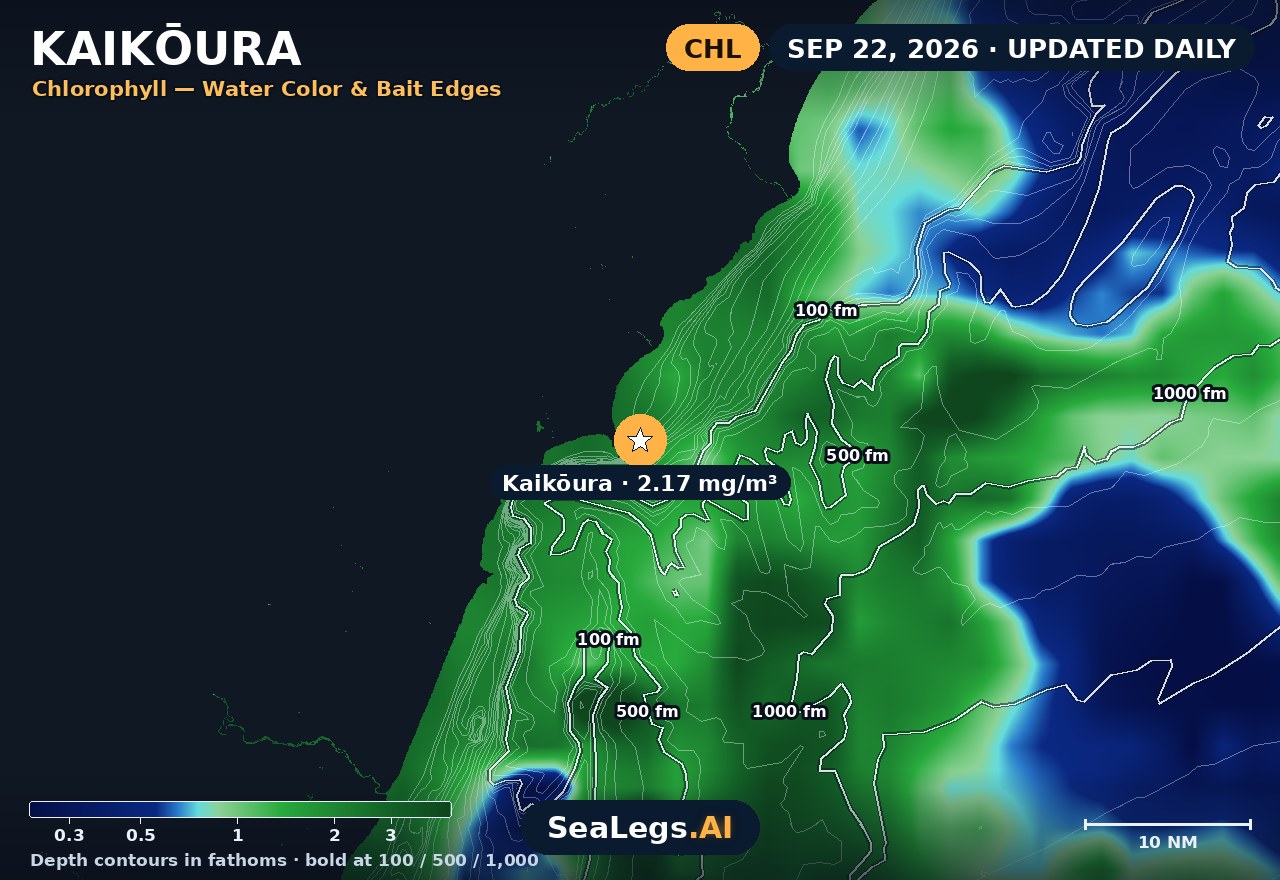
Sea surface temperature and chlorophyll around Kaikōura, imaged fresh every morning. Water at the star is 51.7°F today, and chlorophyll of 3.36 mg/m³ reads as nutrient-rich green water at the spot.
Imagery: Sep 29, 2026 · rebuilt every morning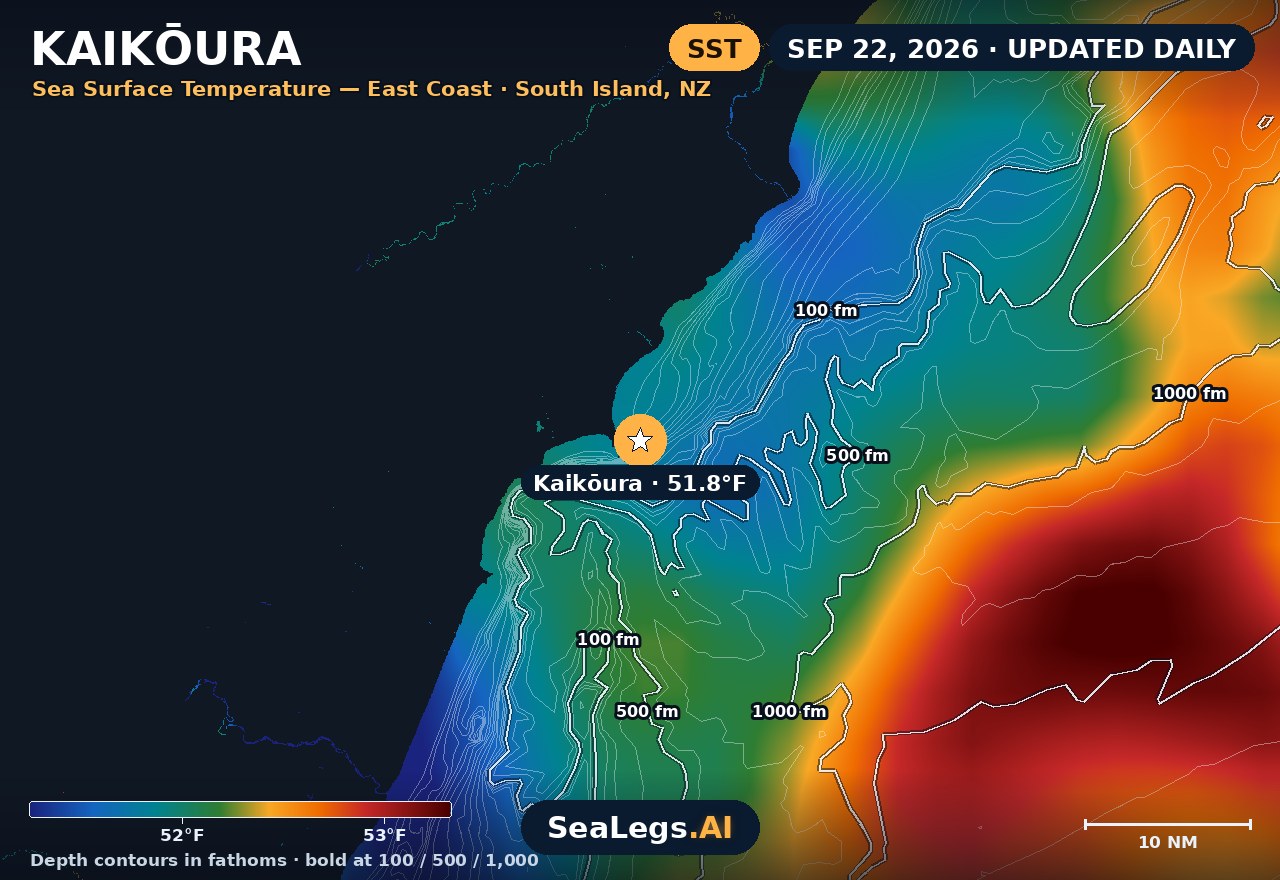
These charts show you the breaks. DeepCast reads them. A zone-by-zone AI fishing report for these exact waters — temperature edges, color changes, and structure, analyzed together.
Get the AI fishing reportSST and chlorophyll from the SeaLegs AI DeepCast satellite pipeline. Charts are a planning aid — always check the official marine forecast before making the run.
About Kaikōura
Kaikōura sits on top of one of the deepest inshore canyons in the world — the seabed drops past 1,000 m within a few nautical miles of the peninsula. That trench is why the sperm whales and big pelagics stay year-round, and why the crayfish (kōura) the town is named for hold on the reef edges. It also means deep water and open ocean are close enough that conditions turn from workable to dangerous in a hurry.
For a small boat off Kaikōura, one thing decides the day: the southerly. The coast is wide open to southerly swell, it builds fast and hard once the change arrives, and a launch that looked fine at dawn can be untenable by mid-morning. The forecast below reads the swell and wind together and gives each of the next three days a plain GO / CAUTION / NO-GO rating — the same AI rating used in the SeaLegs AI app.
Reading conditions at Kaikōura
The peninsula gives you a choice of ramps, and the wind direction tells you which side to use. A northerly lets you work the lee behind the peninsula; a southerly leaves the whole coast exposed, and the swell wraps in around the point. Watch the forecast for a southerly change more than any single wave-height number — Kaikōura swell doesn't ease in gradually, it stacks up quickly behind the front, and the sea state at the ramp can go from a clean launch to a dumping shorebreak inside an hour.
Time your window early. The most reliable pattern is a settled morning ahead of an afternoon southerly, so plan to launch at first light, fish the crayfish reefs and the canyon edge for groper (hāpuku), blue cod and kingfish, and be back on the trailer before the change fills in. If the three-day view shows a southerly building, treat the day it arrives as a NO-GO regardless of how calm the morning starts — getting out is easy, getting back in through a rising southerly swell is what catches people.
Kaikōura forecast FAQ
How is the sea at Kaikōura today?
As of Sep 30, 2026, the SeaLegs AI verdict for Kaikōura is NO-GO. Wednesday is a NO-GO with no settled all-GO stretch long enough for a 12-hour trip. Winds stay light all day at 1-8 kt from the north/northeast, but the sea state is the problem: 5-6.2 ft swell at 10-12 second periods from the south runs through the day, and during the early morning hours (roughly 2:00 AM-4:00 AM) steep wind-wave chop develops on top of it, creating an uncomfortable, confused ride with no good heading. Rain chances peak near 53% around 1:00 PM, adding to the case for staying in.
When is the best time to launch a small boat at Kaikōura?
Early morning, ahead of any forecast southerly change. Kaikōura's coast is fully exposed to southerly swell that builds fast, so the safest window is usually a settled dawn before an afternoon front. Use the lee behind the peninsula when the wind has any north in it, and don't commit to a day the three-day forecast shows a southerly filling in — the return through a rising swell at the ramp is the real hazard, not the trip out.
How accurate is this Kaikōura marine forecast?
The outlook is generated from the latest marine model data and rated GO, CAUTION, or NO-GO by the same AI engine used in the SeaLegs AI app. It's a planning aid, not a substitute for the official MetService marine forecast and any current warnings — always check those before heading out.
How often is this forecast updated?
The page is rebuilt every morning from the latest model run, and the SpotCast card refreshes live in your browser. The date stamp above the outlook shows exactly when it was last generated.
What do GO, CAUTION, and NO-GO mean?
GO means conditions are favourable for most recreational boats. CAUTION means marginal — manageable for experienced crews in capable vessels, but check the wind and sea timing closely. NO-GO means conditions are hazardous for small craft and the trip is best postponed.
Can I get a forecast like this for my own spot?
Yes. In the free SeaLegs AI app you can drop a pin anywhere on Earth — your local ramp, a favourite mark, or a spot well offshore — and get the same AI-rated marine forecast and trip planning.
What is the water temperature at Kaikōura today?
As of Sep 29, 2026, the satellite-derived sea surface temperature at Kaikōura is about 51.7°F, with chlorophyll around 3.36 mg/m³ (nutrient-rich green water). The SST and chlorophyll charts on this page are rebuilt every morning from the SeaLegs AI DeepCast satellite pipeline.
More offshore forecasts
Get this forecast for your own spot
Drop a pin on any spot on planet Earth in the free SeaLegs AI app — AI marine forecasts, fishing reports, and trip planning, rated GO / CAUTION / NO-GO.
📍 Get a Marine Forecast Near You →or download directly: