Lake Erie Boaters ForecastCentral Basin
Updated Mon Sep 28, 2026
Drop a pin on any spot in the world — free in the SeaLegs AI app.


Marine Forecast for Lake Erie Mon Sep 28, 2026
📋
Today’s Water at Lake Erie
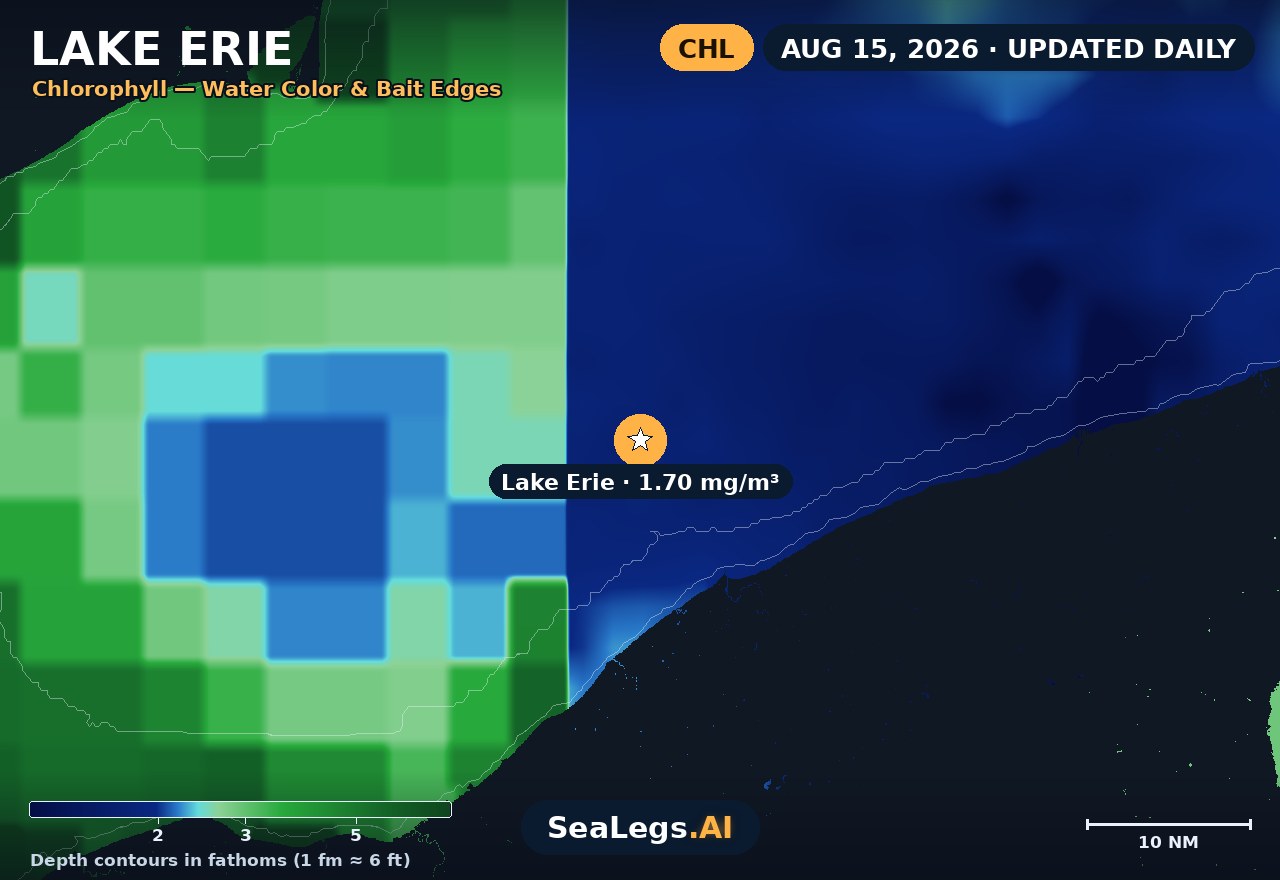
Sea surface temperature and chlorophyll around Lake Erie, imaged fresh every morning. Water at the star is 67.4°F today, and chlorophyll of 4.49 mg/m³ reads as heavy algal-bloom water at the spot.
Imagery: Sep 29, 2026 · rebuilt every morning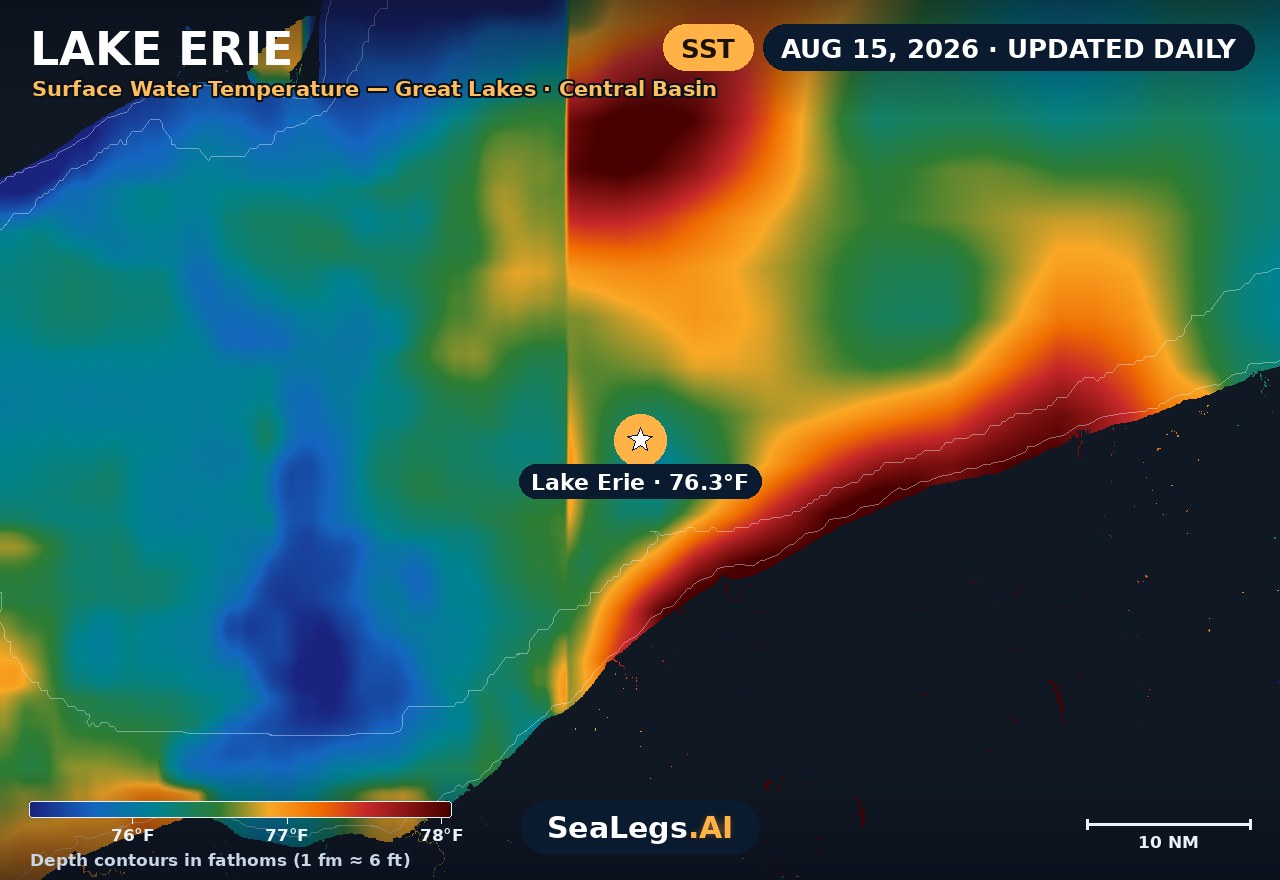
These charts show you the breaks. DeepCast reads them. A zone-by-zone AI fishing report for these exact waters — temperature edges, color changes, and structure, analyzed together.
Get the AI fishing reportSurface temperature and chlorophyll from the SeaLegs AI DeepCast satellite pipeline. These charts are a planning aid — always check the official marine forecast before heading out.
About Lake Erie
Lake Erie is the shallowest of the Great Lakes, and that single fact drives almost everything a boater needs to know about it. Mean depth is only about 62 feet, and the central basin — the water between Cleveland and Erie — averages roughly 60 feet. Shallow water builds a wave faster and steeper than deep water does, so Erie can turn from glass to genuinely dangerous in a couple of hours on a wind nobody would think twice about on Lake Michigan.
Boaters on Erie usually call this a boaters forecast — the wave, wind and period read you check before deciding whether the lake is worth the trip. The forecast below is rebuilt each morning from the latest marine models, and every day gets a plain verdict — GO, CAUTION or NO-GO — the same AI rating used in the SeaLegs AI app.
Reading conditions on Lake Erie
Erie runs roughly southwest to northeast, and that axis is the whole story. A westerly or southwesterly wind blows straight down the long axis with 200-odd miles of open water to work with, and the resulting fetch stacks up a short, steep sea in the central and eastern basins. The same wind speed out of the north or south crosses the lake's narrow dimension and produces far less. Check the wind direction against the lake's axis before you check the speed — on Erie a 15-knot westerly is a bigger problem than a 20-knot northerly.
Watch the wave period as closely as the height. Because the basin is shallow, Erie's waves come at short intervals — 3 to 5 seconds is common — and a 4-foot sea at 4 seconds is a punishing, closely-spaced ride, not the long rolling swell the same height would imply offshore. That steepness is also why conditions deteriorate so quickly here: the lake responds to a building wind almost immediately, and it does not need long to become unmanageable for a small boat.
Erie is also the Great Lake most prone to a seiche. When a strong southwesterly gale pushes water down the long axis toward Buffalo, the whole lake tilts: NOAA notes that in an extreme case the water level at Toledo and at Buffalo can differ by more than 10 feet. When the wind eases the water sloshes back, and the lake rocks for hours — in the Great Lakes the interval between a seiche high and low can run four to seven hours. For a boater that matters twice over: launch ramps and slips at the upwind end can be left dry while the downwind end floods, and the return sloshing shows up as strong, confusing currents in the connecting channels long after the wind has dropped.
Know which forecast you are reading. The National Weather Service issues Lake Erie in two versions — a nearshore forecast for the band within about five nautical miles of the coast, and an open water forecast for the middle of the lake, broken into zones. Nearshore water is shallower and feels a shift sooner; open water builds the bigger sea. This page is computed for a point in open water in the central basin, so treat it as the open-water read and expect the nearshore band to differ, particularly on an offshore wind.
Plan the whole trip, not just the departure. A wind shift forecast for the afternoon can close your window home, and on a lake this shallow the sea state follows the wind with very little lag. The three-day view above is there for exactly that.
Lake Erie forecast FAQ
What area does this Lake Erie forecast cover?
This page covers the central basin of Lake Erie — the open water between the Cleveland and Erie shorelines. The forecast is computed for a point in open water in the middle of the basin, away from the immediate shoreline.
How often is this forecast updated?
The page is rebuilt every morning from the latest marine models, and the SpotCast widget refreshes live in the page. The date above the forecast is the most recent model run.
Why does Lake Erie get rough so quickly?
Because it is shallow. Lake Erie averages about 62 feet deep, and the central basin is shallower still. Shallow water builds steeper, more closely-spaced waves than deep water at the same wind speed, and it responds to a rising wind with very little delay. A westerly wind also has the lake's full long axis to work across, which is why direction matters as much as speed here.
How big are the waves going to be on Lake Erie today?
The wave height for the central basin is in the forecast above, updated every morning from the latest marine model run, with the three-day outlook beside it. Read the period as well as the height — Erie's waves are closely spaced, and a 4-foot sea at 4 seconds is a far harder ride than the same height with a long period would be.
How long will a Lake Erie seiche last?
In the Great Lakes the interval between a seiche high and low can be as much as four to seven hours, and the lake keeps oscillating with decreasing force after that. NOAA notes that in an extreme case Lake Erie water levels at Toledo and Buffalo can differ by more than 10 feet. The effect is strongest after a sustained southwesterly gale along the lake's long axis.
What is the difference between the nearshore and open water forecast for Lake Erie?
The nearshore forecast covers roughly the first five nautical miles off the coast; the open water forecast covers the middle of the lake and is issued by zone. Nearshore is shallower and reacts to a wind shift sooner, while open water builds the larger sea. This page is computed for a point in open water in the central basin.
What do GO, CAUTION and NO-GO mean?
GO: favorable conditions for most recreational boats. CAUTION: marginal conditions — workable for experienced crews watching the wind and wave period closely. NO-GO: dangerous conditions for small craft; better to postpone.
Can I get this forecast for my own spot?
Yes. In the free SeaLegs AI app you can drop a pin anywhere on the planet — your slip, a reef, a fishing spot — and get the same AI-rated marine forecast, with fishing reports and trip planning.
What is the water temperature at Lake Erie today?
As of Sep 29, 2026, the satellite-derived sea surface temperature at Lake Erie is about 67.4°F, with chlorophyll around 4.49 mg/m³ (heavy algal-bloom water). The SST and chlorophyll charts on this page are rebuilt every morning from the SeaLegs AI DeepCast satellite pipeline.
More offshore forecasts
Get this forecast for your own spot
Drop a pin on any spot on planet Earth in the free SeaLegs AI app — AI marine forecasts, fishing reports, and trip planning, rated GO / CAUTION / NO-GO.
📍 Get a Marine Forecast Near You →or download directly: