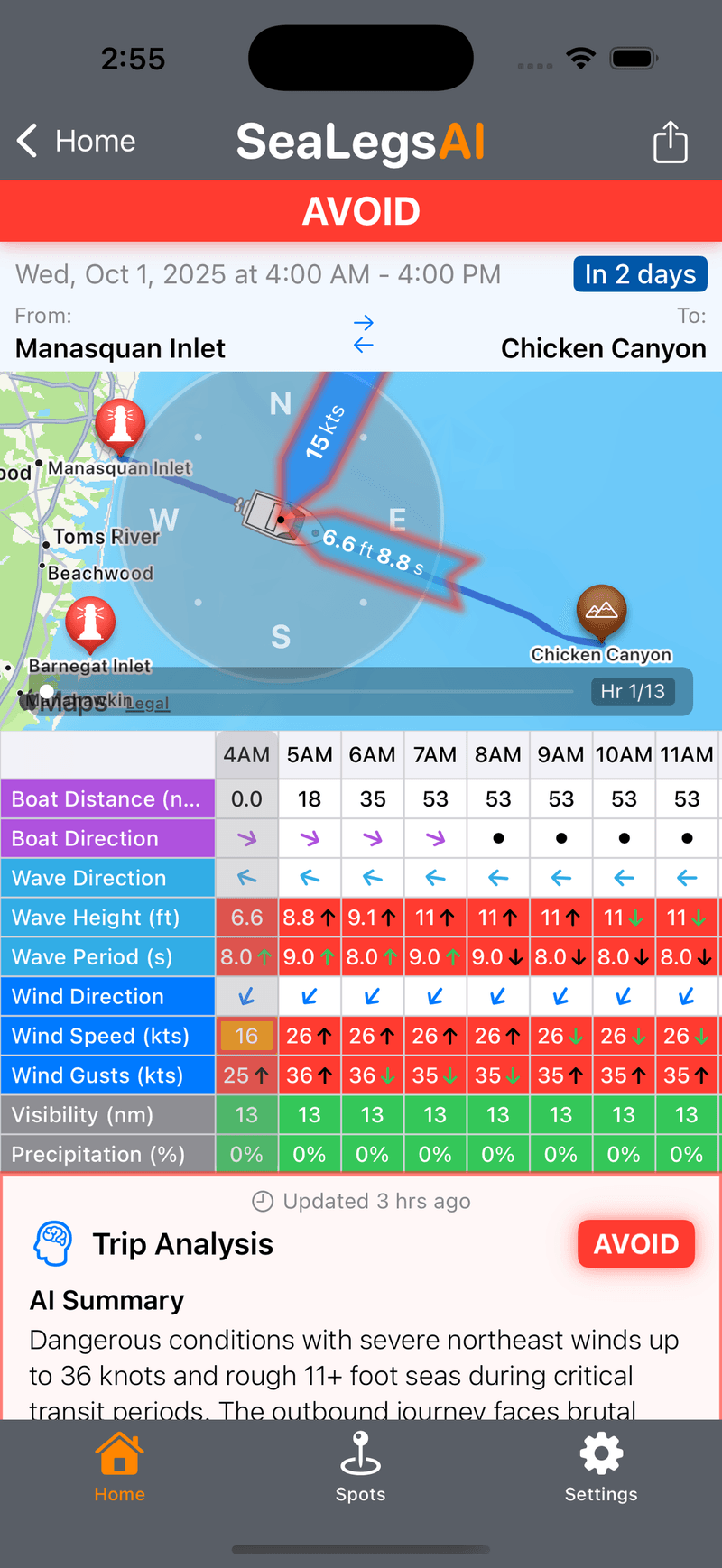


A gale warning is issued by NOAA's National Weather Service when sustained winds — or frequent gusts — of 34 to 47 knots (about 39–54 mph) are expected or already happening over the water, and are not part of a tropical system.
That's the whole definition, and two words in it do most of the work: it's a warning, not an advisory, and the trigger includes gusts, not just steady wind. Both matter, and we'll come back to them.
For a sense of scale: 34 knots is the bottom of Beaufort force 8. It is the wind speed at which the sea surface stops being a texture and starts being terrain — spray blowing in streaks, breaking crests, a working deck that no longer holds still. A gale warning is not a “be careful” flag. It's the weather service telling you the water is now genuinely hazardous to be on.
Where it sits on the ladder
Marine wind alerts run in tiers, roughly by wind speed. From the bottom up:
| Alert | Sustained wind | Tier | The honest read |
|---|---|---|---|
| Small Craft Advisory | ~20–33 kt | Advisory | A decision |
| Gale Warning | 34–47 kt | Warning | A no |
| Storm Warning | 48–63 kt | Warning | Stay in port |
| Hurricane Force Wind Warning | 64 kt and up | Warning | Survival conditions |
The jump that matters for most people is the one from the row above the gale to the gale itself — from advisory to warning.
A small craft advisory is a genuine judgment call: your boat, your water, your crew, your trip all feed into a go / no-go decision, and reasonable, experienced boaters make that call differently. A gale warning is not that. The National Weather Service has moved the conditions into the warning tier — hazardous weather expected or occurring — and for a recreational boater the answer is essentially made for you. The interesting questions on an advisory day (is the wind against the tide? what's the trend?) mostly stop being interesting in a gale, because the baseline conditions are already past the line.
If you want the full ladder — including watches, statements, and the short-fused special marine warning — that's the marine warning guide, the hub these all hang off.
“Warning” is a tier, and this one earns it
It's worth being precise about the vocabulary, because it's exactly where people misread the severity:
- Statement — information; something to be aware of.
- Advisory — hazardous conditions expected, but below warning severity. (This is where the small craft advisory lives.)
- Watch — warning-severity conditions are possible; get ready.
- Warning — hazardous conditions are happening or imminent.
A gale warning is a warning. That's the top tier of that scale, and the word is not being borrowed loosely. The difference between an advisory and a warning is the difference between “conditions may make this a bad idea” and “conditions are now dangerous.” Unlike the word advisory — which reads, in plain English, like optional advice — warning means what it says.
Gale Watch vs Gale Warning: the timing tells you what to do
You'll also see a gale watch, and the difference is about lead time and what it asks of you:
- A gale watch means gale-force winds are possible, usually somewhere in the next day or so. It's a get ready signal — finish the trip you're on, double-check the forecast, secure the boat, don't start anything long.
- A gale warning means those winds are expected or already occurring. It's a this is happening signal — the window for being out has closed.
The practical read: a watch is your cue to make plans, a warning is your cue to have already made them.
The detail most articles skip: “frequent gusts”
Here's the part that thin definitions leave out, and it's the part that actually protects you.
A gale warning can be issued for frequent gusts in the 34–47 knot band — not only for sustained winds that high. That means you can get a gale warning on a day when the steady wind reads in the high 20s or low 30s, because the gusts are punching into gale force often enough to be dangerous.
Why it matters: gusts are what capsize small boats and knock down sailors, and they don't show up in the single “wind speed” number people tend to check. A forecast of “25 knots gusting 40” is a very different, and more dangerous, sea than a flat 25 — and it can absolutely carry a gale warning. When you read the warning, read the gust figure, not just the sustained number.
What a gale does to the water
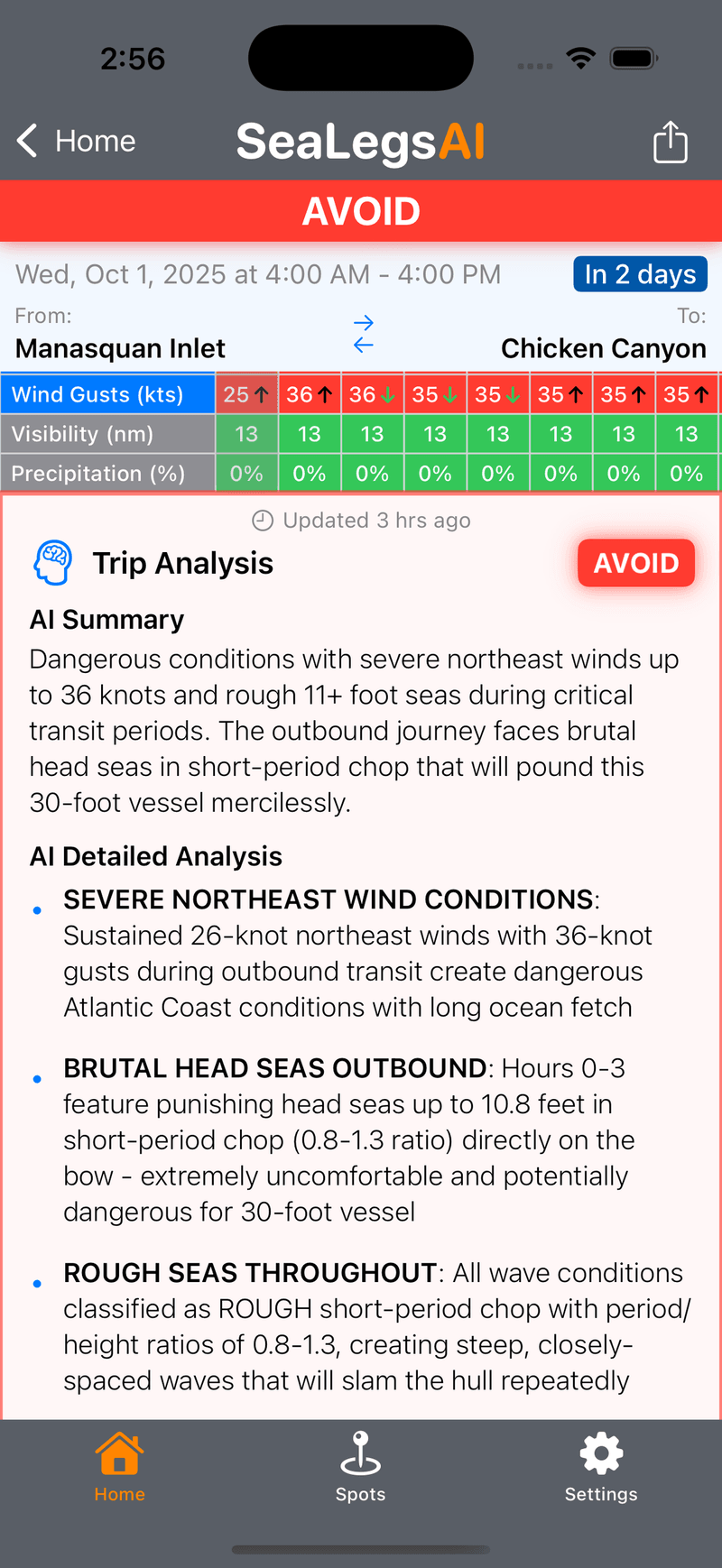
The wind is only half of it. Sustained 34–47 knots builds seas fast, and the danger scales with how steep those seas get, not just how tall:
- Height climbs quickly, especially where wind blows over a long stretch of open water (that's fetch).
- Period matters more than height. A gale-driven sea is often short-period — steep, close-together waves that break and stack rather than roll. Six feet at six seconds in a building gale is a wall; the same height at a long period is merely uncomfortable. That distinction is the whole point of wave height and period.
- Inlets and bars turn vicious. A gale against an outgoing tide at an inlet mouth produces some of the most dangerous water a small boat ever sees. This is where “I'll just run in quick” gets people.
The wind number gets the headline. The sea state is what actually hurts the boat.
See the gust and the sea state behind the warning
- Sustained wind and the gust figure, hour by hour — a gale can fire on gusts alone.
- Wave height and period at your spot — short-period gale seas are the dangerous kind.
- Tide at your inlet, and a clear Go / Caution / Avoid call for your exact location and time.
So — can you boat in a gale warning?
Legally, for U.S. recreational boaters, a gale warning is not a closure. The Coast Guard is not going to physically stop you, and no federal rule chains your boat to a forecast product. (Commercial and charter operations answer to their own rules and insurers, and some local facilities restrict launching.)
But unlike the small craft advisory, where “can I go?” is a real question, in a gale the honest answer is short: for almost every recreational boater, no. Not because it's forbidden — because 34–47 knots and the seas that come with it are beyond what recreational boats and crews should be handling for anything short of an emergency.
The situations where gale conditions get taken on deliberately are narrow and specific: experienced offshore sailors on capable, prepared boats who are caught out or committed to a passage, working professionals, and rescue operations. If you're deciding whether to run out for a few hours of fishing, you're not in that category, and the gale warning is doing its job by telling you so.
If you're already out when one is issued
Gales sometimes arrive faster than forecast, or you're on a long trip when the warning goes up. If you're caught:
- Head for shelter early, not at the last minute. The water gets worse over time in a building gale; the easiest version of the trip home is the one you start now.
- Mind the inlet, not just the ocean. The most dangerous water is often the entrance you have to cross to get in — especially wind against tide. Time it, or pick a different, safer inlet even if it's farther.
- Everyone in life jackets, now. Not when it gets bad. Now.
- Slow down and quarter the seas. Take steep waves at an angle, keep steerage, don't bury the bow. Power through, don't fight.
- Tell someone. A float plan, a radio call, a location shared — so if it goes wrong, help knows where to start.
A gale is survivable seamanship for a prepared boat and crew. The point of the warning is to make sure you're never taking it on by accident.
Gale warning vs. the neighbors
Two comparisons people search directly:
Gale warning vs. small craft advisory — different tiers, and the difference is the decision. An SCA (~20–33 kt) asks you a question. A gale (34–47 kt) has answered it. If the SCA is the line where judgment matters, the gale is past that line.
Gale warning vs. special marine warning — these are on different axes, and it's a common mix-up. A gale warning covers sustained dangerous wind over hours across a zone. A special marine warning is a short-fused alert — minutes to a couple of hours — for a specific, sudden hazard like a squall line, waterspout, or thunderstorm gust front. You can get a special marine warning on an otherwise calm afternoon, and you can be in a gale with no special marine warning at all. One is the sustained ladder; the other is the sudden-hazard flag.
The bottom line
- A gale warning means sustained winds — or frequent gusts — of 34–47 kt (about 39–54 mph), expected or occurring, and not from a tropical system.
- It's a warning, a full tier above the small craft advisory. The word is not loose — the water is dangerous.
- Read the gust figure, not just the sustained number — a gale can fire on gusts alone.
- For almost every recreational boater, a gale warning is a no. Deliberate gale conditions are for prepared, experienced crews and professionals.
- If you're caught out: shelter early, mind the inlet, life jackets on, quarter the seas, tell someone.