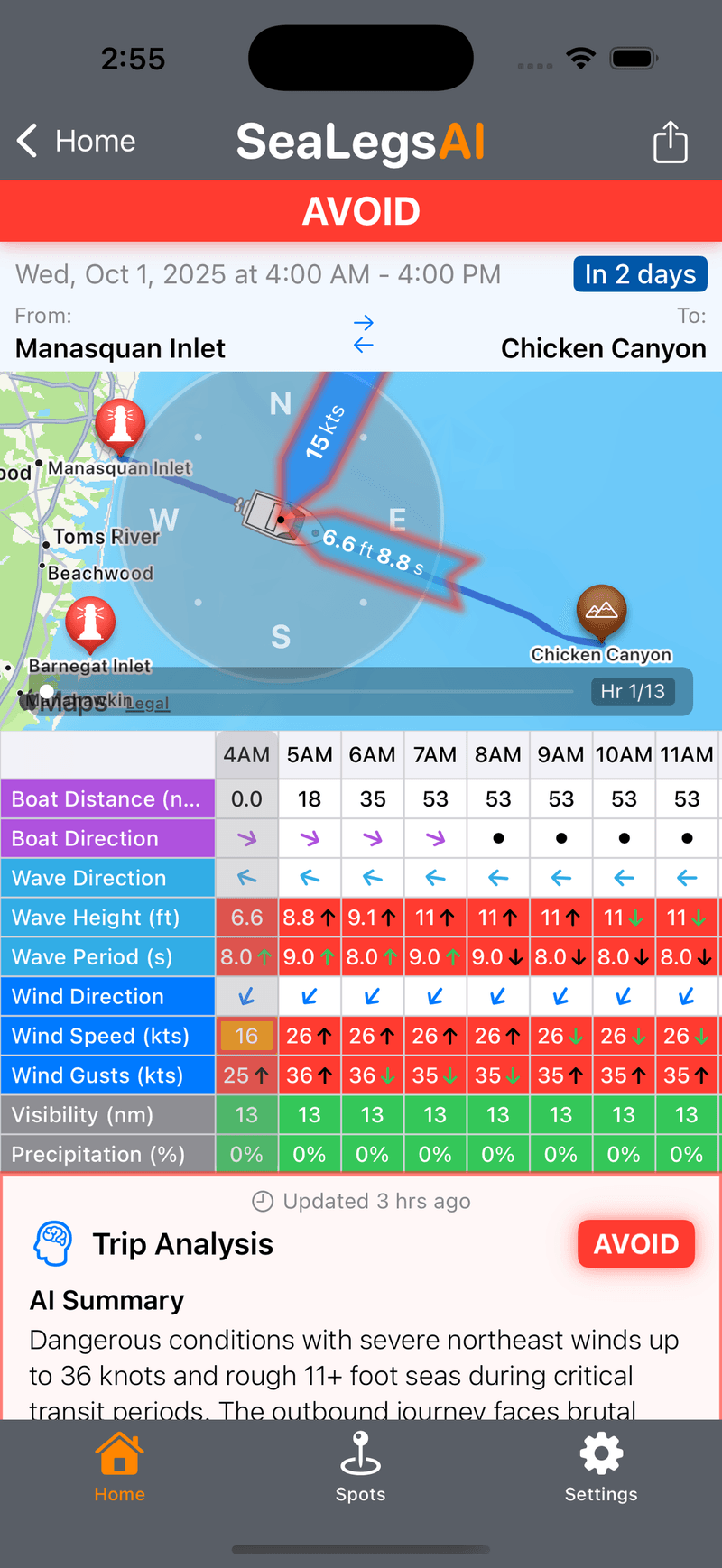
A marine warning is an official alert issued by NOAA's National Weather Service (NWS) when hazardous conditions are happening, or about to happen, on the water. It's the marine equivalent of the alerts you already know from land — but tuned to the things that sink boats and ruin trips: wind, seas, thunderstorms, and freezing spray.
The single most useful thing to understand is that "marine warning" is a category, not a single alert. NWS issues a graduated set of marine products, and they are ranked — mostly by sustained wind speed. Knowing where an alert sits on that ladder tells you, at a glance, how seriously to take it.
The marine alert ladder, by wind speed
Here's the hierarchy NWS uses for wind-based marine hazards, from least to most severe. Thresholds are in knots (kt) — 1 knot is about 1.15 mph.
| Alert | Sustained wind / gusts | What it means for you |
|---|---|---|
| Small Craft Advisory (SCA) | ~22–33 kt (or hazardous seas) | Conditions dangerous to small boats. Many recreational boats should stay in. Threshold varies a little by region and sea state. |
| Gale Warning | 34–47 kt | Strong, dangerous winds. Most recreational boaters should not be out. |
| Storm Warning | 48–63 kt | Very dangerous. Open-water conditions that threaten larger vessels. |
| Hurricane Force Wind Warning | 64+ kt | Extreme, non-tropical hurricane-strength winds. Life-threatening. |
Two important notes:
- A Small Craft Advisory is an advisory, not a warning — it's the lowest rung, but for a 19-foot center console it's often the most important line on the page. "Advisory" doesn't mean "optional."
- During tropical systems (hurricanes, tropical storms), NWS switches to tropical products — Hurricane Warning, Tropical Storm Warning — rather than the Storm/Gale ladder above. Same water, different vocabulary.
Special Marine Warning — the one that catches people off guard
The alert that surprises the most boaters is the Special Marine Warning (SMW). It's issued for short-fused, severe, local events — usually a thunderstorm or squall line — that can produce:
- Sudden winds of 34 knots or more (often as gusts), and/or
- Frequent lightning, hail, or waterspouts.
An SMW typically covers a brief window — often two hours or less — because that's how fast a squall moves through. The danger is exactly that it's sudden: flat water and sunshine can turn into 40-knot gusts and a waterspout in fifteen minutes. If you get an SMW for your area, it means a dangerous cell is bearing down now — get off the water or get to shelter. (For the full breakdown — exact criteria, how long it lasts, and what to do — see our dedicated guide to what a Special Marine Warning is.)
Just got a Special Marine Warning? Check these 3 things first.
- Your exact wind & gust forecast for the next 1–2 hours — not the zone average.
- Wave height and period on your route — short-period chop is what flips small boats.
- A clear Go / Avoid call for your exact spot and departure window.
Marine Weather Statement — information, not alarm
A Marine Weather Statement (MWS) is the product people search for most often without knowing what it is. It is not a warning. It's NWS communicating information that doesn't meet warning criteria, such as:
- A follow-up or update to an existing Special Marine Warning.
- A heads-up about marginal or developing conditions — a line of storms that might strengthen.
- Notice of a significant but non-warning event (dense fog, a wind shift, hazardous seas building).
Think of a Marine Weather Statement as NWS tapping you on the shoulder: "Here's something to keep an eye on." It's lower-urgency than any warning or advisory, but it's often the earliest signal that conditions are about to change — which makes it valuable if you're already watching the sky.
Watch vs. Warning vs. Advisory vs. Statement
These four words are the whole game, and they mean specific, different things:
- Watch — conditions are possible. Be prepared, keep checking. (e.g., Gale Watch, Storm Watch.)
- Warning — conditions are occurring or imminent. Take action now.
- Advisory — a hazard that's serious but generally less severe than a warning (the Small Craft Advisory is the classic example).
- Statement — information. Context, follow-ups, or developing situations that don't rise to a warning.
Watch = maybe, Warning = now, Advisory = caution, Statement = FYI.
How to turn all of this into a go / no-go
You don't need to memorize knot thresholds to use this. The decision rule for most recreational boaters is short:
- Any warning (Gale, Storm, Special Marine, Hurricane Force) → don't go. Full stop.
- Small Craft Advisory → don't go unless your boat and experience clearly exceed the conditions, and even then, know your limits. The advisory exists because of boats like yours.
- Marine Weather Statement → go only with a plan to bail early. Conditions are uncertain; treat the water as a place you'll leave at the first sign things turn.
- No alerts → still read the actual forecast. "No warnings" is not the same as "good conditions" — wind, wave period, and timing still decide the day. (See our guide to reading a marine forecast.)
It isn't ignoring a Storm Warning — almost nobody does that. It's treating a Small Craft Advisory as a suggestion, or not knowing a Special Marine Warning can appear an hour after a clear-sky departure.
Where to find marine warnings — and why one source isn't enough
NOAA broadcasts marine warnings over VHF radio (NOAA Weather Radio), the NWS marine forecast pages, and Coast Guard channels. They're free and authoritative, and you should always have a VHF aboard.
The gap is that NWS warnings are issued for broad marine zones — sometimes hundreds of square miles — and on NWS's own schedule. A warning that's accurate for the offshore edge of a zone may not reflect the chop in the specific inlet you're running. That's the difference between a zone warning and a forecast for your exact launch point, departure time, and route.
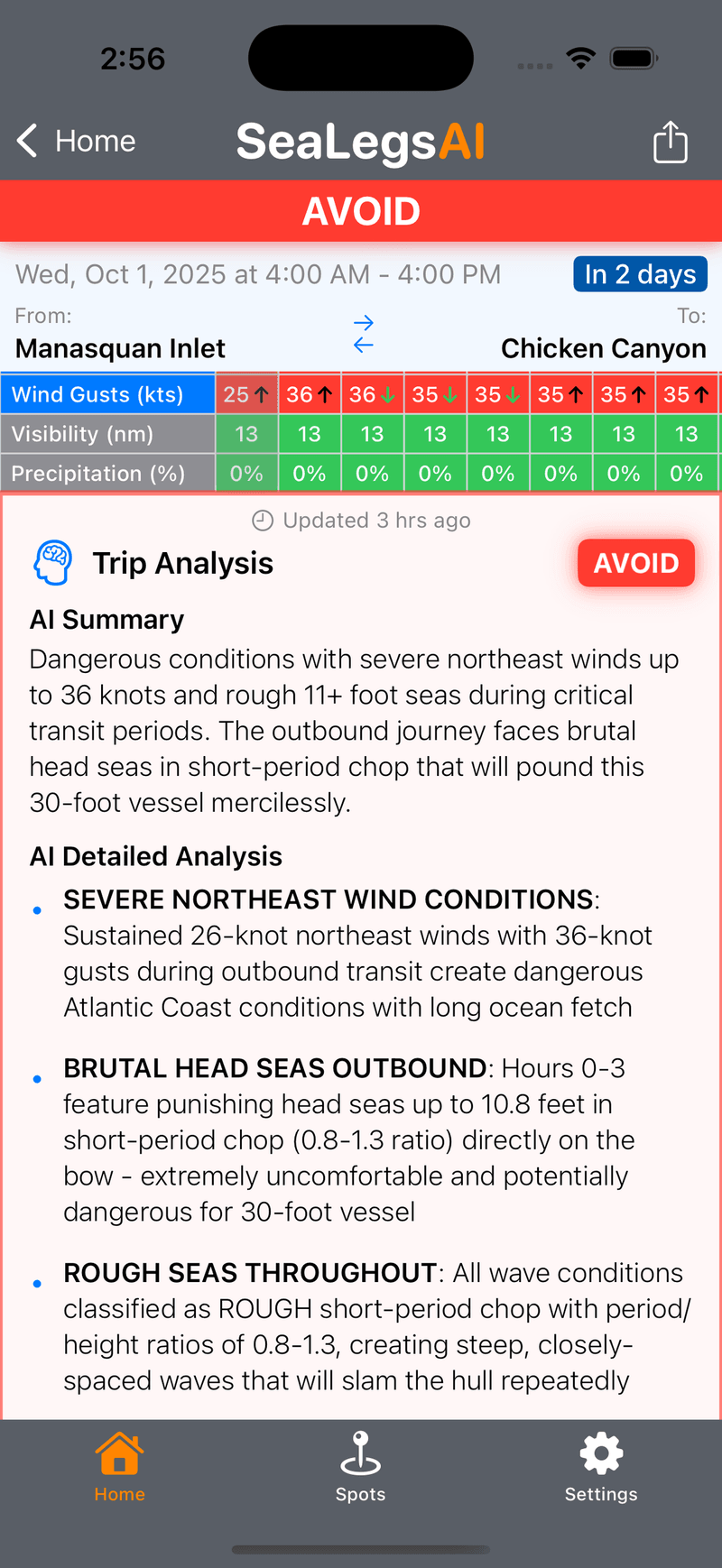
SeaLegs AI is built to close that gap: it pulls the official NOAA zone forecasts and warnings and layers point-specific wind, wave height, wave period, and AI-analyzed conditions for the exact spot and time you're heading out — so the "should I go" answer is about your trip, not a 400-square-mile zone average. The official warning tells you the zone is dangerous; a point forecast tells you whether your window is the bad part of it.
The bottom line
- Marine warning is a category of NOAA alerts, ranked mostly by wind speed.
- The ladder: Small Craft Advisory (~22–33 kt) → Gale (34–47) → Storm (48–63) → Hurricane Force (64+).
- Special Marine Warning = a sudden, severe, short-lived storm hazard — the one that catches people off guard.
- Marine Weather Statement = information, not an alarm — often the earliest signal conditions are shifting.
- Watch = maybe, Warning = now, Advisory = caution, Statement = FYI.
- A warning means don't go. An advisory means don't go unless you clearly out-class the conditions. No alert still means read the forecast.