

You check the marine forecast and see "seas 3 to 4 feet." Sounds manageable. But when you get out there, it's a washing machine—steep, relentless chop that has your passengers gripping the rail and regretting breakfast.
The next week, the forecast says "5-foot swells." You almost cancel. But it turns out to be a beautiful ride—long, gentle rollers that the boat glides over effortlessly.
What happened? Wave period. It's the single most important number in a wave forecast, and most boaters either ignore it or don't know what it means.
Wave Height: What the Number Actually Means
When a marine forecast reports wave height, it's giving you the significant wave height—the average of the tallest one-third of waves over a measurement period. It's not the biggest wave you'll see. It's not the average of all waves. It's somewhere in between.
The Waves You'll Actually Encounter
Because significant wave height is an average of the top third, you will regularly encounter waves both smaller and larger than the reported number:
| If Forecast Says | Most Waves | 1 in 10 Waves | 1 in 100 Waves |
|---|---|---|---|
| 2 feet | 1–2 ft | ~2.5 ft | ~3.3 ft |
| 4 feet | 2–4 ft | ~5 ft | ~6.6 ft |
| 6 feet | 3–6 ft | ~7.6 ft | ~10 ft |
| 8 feet | 4–8 ft | ~10 ft | ~13.3 ft |
This is why experienced boaters mentally add 50% to any reported wave height when assessing risk. A "4-foot sea" means you should be prepared for 6-foot waves showing up regularly.
Significant wave height is not the maximum wave height. Always assume you'll encounter waves 1.3 to 1.7 times the reported height during your trip.
Wave Period: The Number That Changes Everything
Wave period (also called swell period) is the time in seconds between consecutive wave crests passing the same point. It tells you how far apart waves are spaced and, critically, how steep they are.
Here's why it matters so much: two waves with the same height but different periods create completely different conditions.
Rough Ride
3 ft seas, 4-second period
Waves spaced ~80 feet apart. Steep, choppy, and relentless. Your boat pitches and slams. Spray everywhere. Uncomfortable at any speed.
Comfortable Ride
5 ft swells, 12-second period
Waves spaced ~730 feet apart. Long, gentle rollers. Your boat rises and falls smoothly. You barely notice them at cruising speed.
The 5-foot swell is taller but feels dramatically better because the waves are spaced so far apart that the slope is gentle. The 3-foot chop is shorter but the waves stack on top of each other, creating a steep, punishing ride.
Period Quick Reference
| Period | Wave Spacing | Type | Ride Quality |
|---|---|---|---|
| Under 5 sec | ~40–130 ft | Short wind chop | Rough — steep, jarring, fatiguing |
| 5–7 sec | ~130–250 ft | Moderate wind waves | Choppy — uncomfortable but manageable |
| 8–10 sec | ~330–510 ft | Transitional / short swell | Moderate — organized, predictable motion |
| 10–14 sec | ~510–1000 ft | Long-period swell | Smooth — gentle rolling, easy to navigate |
| 14+ sec | ~1000+ ft | Ground swell | Very smooth — barely noticeable offshore |
If the period is under 6 seconds, reduce whatever wave height you're comfortable with by about half. If you'd normally go out in 4-foot seas, think twice when the period is 5 seconds—it will feel like 4-foot seas at 10 seconds feel closer to 2-foot comfort level.
Wind Waves vs. Swell: Two Different Animals
Marine forecasts often report wind waves and swell separately, plus a combined sea height. Understanding the difference matters because they behave very differently on the water.
Wind Waves (Chop)
- Generated by local wind blowing across the water
- Short periods, typically 2–7 seconds
- Irregular, steep, and disorganized
- Build quickly when wind increases, die quickly when wind drops
- Worst when wind has a long fetch—unobstructed distance over water
Swell
- Generated by distant weather systems, sometimes thousands of miles away
- Long periods, typically 8–20 seconds
- Organized, smooth, and predictable
- Can persist for days after the generating storm dissipates
- Travels across entire ocean basins with minimal energy loss
Combined Seas
Most real-world conditions are a mix of both. A forecast might read: "Wind waves 2 feet at 4 seconds, swell 4 feet at 10 seconds, combined seas 5 feet." The combined sea height isn't simply added—it's calculated as the square root of the sum of squares. But what matters practically is that you'll feel both wave systems simultaneously.
The worst combination: moderate wind chop on top of a crossing swell from a different direction. This creates confused, irregular seas that are hard to predict and uncomfortable from every angle.
Sea-State Words: What "Slight," "Moderate," and "Rough" Really Mean
Forecasts don't only give you a number—they give you a word. "Slight seas." "Moderate." "Rough." These aren't loose adjectives; they map to a standard scale (the Douglas sea state) that every marine forecaster uses. Learn the words and you can read a forecast at a glance, even before you get to the numbers.
| Forecast Word | Significant Wave Height | What You'll Feel |
|---|---|---|
| Calm / Smooth | 0–1.5 ft (0–0.5 m) | Glassy to gently rippled. Any boat, any passenger. |
| Slight | 1.5–4 ft (0.5–1.25 m) | Noticeable but easy. Comfortable for most small craft. |
| Moderate | 4–8 ft (1.25–2.5 m) | A real sea. Fine for a capable boat; green crew will feel it. |
| Rough | 8–13 ft (2.5–4 m) | Demanding. Experienced hands and a seaworthy boat only. |
| Very Rough / High | 13 ft+ (4 m+) | Stay in unless you have a reason and a vessel built for it. |
Two things change how any of these actually feel, and both come back to the rest of this article:
- Period. "Moderate seas" at a 5-second period is a steep, punishing chop. The same height at a 12-second period is a long, rolling ride you'll barely notice. The word describes the height—the period decides the comfort.
- Long swell vs. short chop. A long swell (a long-period groundswell that has traveled from a distant storm) arrives as smooth, widely-spaced rollers—easy water even at height. A short, wind-driven chop at the same height is the washing machine. When a forecast pairs a modest height with a long period, that's a good day.
"Moderate seas, long-period swell" and "moderate seas, short wind chop" are the same height and completely different days on the water. Never judge a forecast on the descriptive word alone—pair it with the period every time.
How Wave Direction Affects Your Ride
The same waves feel very different depending on your heading relative to them:
- Head seas (waves on the bow): Pitching motion. Slows you down, creates spray. Most boats handle this adequately at reduced speed.
- Following seas (waves from behind): Can cause surfing or broaching in steep conditions. Generally comfortable at moderate speeds in organized swell.
- Beam seas (waves from the side): Rolling motion. Most uncomfortable for passengers. Can be dangerous in steep, short-period waves.
- Quartering seas (waves at 45 degrees): Combined pitch and roll. Often the trickiest to manage, especially in short-period chop.
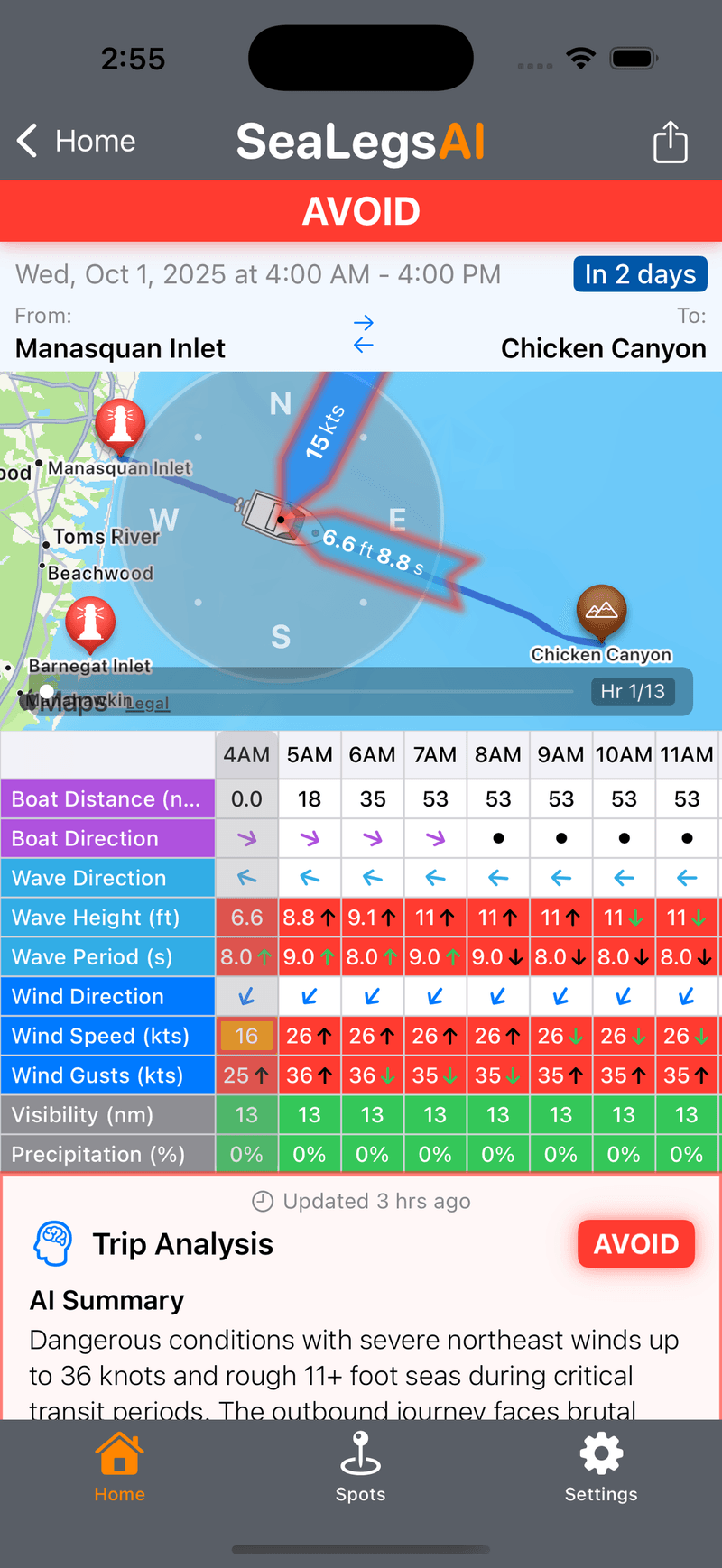
When conditions are marginal, plan your route so the worst seas are on your bow or stern rather than your beam. A heading change of 20–30 degrees can dramatically improve comfort. SeaLegs AI factors wave direction into its trip analysis, so your Go/Caution/Avoid recommendation already accounts for how waves interact with your planned route.
Reading a Wave Forecast: Putting It Together
Here's how to evaluate a wave forecast step by step:
- Check the period first. If it's under 6 seconds, conditions will feel rougher than the height suggests.
- Look at the combined sea height. Add 50% mentally for the bigger sets you'll encounter.
- Check for crossing seas. If wind waves and swell come from different directions, expect confused, uncomfortable conditions.
- Factor in wind. Active wind on top of existing swell means conditions are building and may worsen. Read our full guide on wind forecasts.
- Consider the trend. Is the period increasing (conditions improving) or decreasing (conditions deteriorating)?
Example Forecast Breakdown
Let's say the forecast reads: "Wind waves 2–3 feet at 5 seconds from the south. Swell 3–4 feet at 9 seconds from the east. Combined seas 4–5 feet."
- The swell (9 seconds) is reasonably organized—not butter-smooth, but manageable.
- The wind chop (5 seconds) is moderate and coming from a different direction than the swell.
- Crossing seas from south (chop) and east (swell) will create an irregular, confused pattern.
- Combined 4–5 feet with crossing components means you should expect occasional waves up to 7 feet from unpredictable directions.
- Assessment: CAUTION — experienced boaters in larger vessels can handle it, but smaller boats and less experienced operators should wait for the wind chop to subside.
When to Trust the Numbers and When to Stay In
There's no universal "safe wave height" because the answer always depends on period, direction, your boat, and your experience. But here are general guidelines:
| Boat Size | Comfortable (8+ sec period) | Manageable (6-8 sec) | Stay In (under 6 sec) |
|---|---|---|---|
| Under 18 ft | Up to 3 ft | Up to 2 ft | 1–2 ft max |
| 18–25 ft | Up to 5 ft | Up to 3 ft | Up to 2 ft |
| 25–35 ft | Up to 6 ft | Up to 4 ft | Up to 3 ft |
| 35+ ft | Up to 8 ft | Up to 6 ft | Up to 4 ft |
These are conservative guidelines for recreational boaters. Operator experience, boat design, and loading all affect what's actually safe. When in doubt, don't go out.
Evaluating wave height, period, direction, wind interaction, and your specific route is a lot to juggle. SeaLegs AI analyzes all of these variables for your exact trip coordinates and synthesizes them into a single Go, Caution, or Avoid recommendation—so you don't have to become a meteorologist to make a safe call.