The short answer
A Small Craft Advisory (SCA) is an alert issued by NOAA's National Weather Service when wind or sea conditions are expected to be dangerous to small boats — typically sustained winds in the low 20s to low 30s of knots, or waves steep and high enough to be hazardous regardless of the wind.
It is the lowest rung on the marine alert ladder. And it is, for most recreational boaters, the most important one on the page — because the rungs above it (gale, storm, hurricane force) are decisions almost nobody has to think about. Nobody is agonizing over whether to take the family out in a gale warning. The SCA is the one that sits right on the line where judgment actually matters.
The question everyone is really asking: how small is a "small craft"?
Here is the thing that surprises people, and it's the reason this alert generates so much confusion:
NOAA does not define it. There is no length cutoff. No "under 33 feet." No tonnage, no horsepower, no hull type. The National Weather Service deliberately leaves "small craft" undefined and puts the call on you.
That sounds like a dodge. It isn't — it's an admission that the honest answer depends on things a forecast office cannot know:
- The boat. A 24-foot deep-V with a bracket and a full transom handles a 25-knot afternoon very differently than a 24-foot flats skiff with low freeboard.
- The water. Twenty-five knots on a protected sound is a lumpy, annoying day. The same 25 knots at an inlet mouth with an outgoing tide running against it is a genuinely dangerous one.
- The crew. Your ability to handle the boat when it stops being fun is part of the equation, and so is everyone else's willingness to be aboard while you do.
- The trip. Ten minutes to a lee shore is a different exposure than forty miles offshore with a following sea building on the way home.
So the useful reframe is: an SCA is not a rule about boat length. It's a flag that says conditions have crossed from "check the forecast" into "make a decision." The advisory does the first half of the work. You do the second half.
What triggers one
SCA criteria come in a few flavors, and it matters which one you're looking at — because they fail you in different ways.
| Trigger | Roughly what it means | Why it matters |
|---|---|---|
| Wind | Sustained winds roughly in the 20–33 knot band (about 23–38 mph); the lower cutoff varies by region | The classic case. The number that gets quoted. |
| Hazardous seas | Wave height and steepness dangerous to small boats — even if the wind is light | The one that catches people. Flat-calm morning, leftover 6-foot groundswell at a short period. |
| Rough bar | Breaking or steep conditions at a river bar or inlet entrance | Regional (Pacific Northwest especially). The hazard is a hundred yards wide and will end your day. |
Two things worth internalizing:
The wind numbers vary by region. The low end of the band is not one national number — different NWS offices set different thresholds for their waters, because a threshold that makes sense on the open Atlantic doesn't on the Great Lakes or an enclosed bay. Read the advisory text for your zone, not a number you memorized from an article.
You'll see this phrase in forecast text. It's a heads-up, a step below an SCA — conditions approaching the threshold without meeting it. It's not a formal product and it's not the same alert. If you're using it as a green light, you're using it wrong; it's precisely the marginal day that deserves the most thought.
"Advisory" is a tier, not an opinion
The word does real damage here. In NWS vocabulary the ladder is:
- Statement — information; something to watch.
- Advisory — hazardous conditions are expected, but not to warning severity.
- Watch — warning-severity conditions are possible; be ready.
- Warning — hazardous conditions are happening or imminent.
An advisory is genuinely a lower tier than a warning. That's the hierarchy and it's correct. But "advisory" reads, in ordinary English, like advice — optional, take-it-or-leave-it. And that's the gap the alert falls into: it's the lowest formal tier and it's the one aimed squarely at the boats most likely to be hurt by it. The tier describes the conditions. It doesn't describe how much they should matter to you.
If you want the full ladder — advisory, gale, storm, hurricane force, plus the short-fused special marine warning that comes with squall lines — that's the marine warning guide. The sudden-storm alert that can appear an hour after a clear-sky departure is the special marine warning.
Can you legally go out in a small craft advisory?
For recreational boaters in the U.S.: generally, yes. An SCA is not a closure. The Coast Guard is not going to stop you at the jetty, and no federal rule ties your dock lines to a forecast product. (Local exceptions exist — some harbors, parks, and launch facilities do restrict or close on an advisory, and commercial and charter operations answer to their own rules and insurers.)
But "legal" is the least interesting question, and it's not the one the search is really about. The useful questions are:
- Is my exposure survivable if the forecast is wrong in the bad direction? Forecasts have error bars. An advisory day that comes in at the high end of the range is a very different day.
- Is the wind against the tide? Wind-over-tide is the standard mechanism by which a 22-knot forecast becomes a genuinely dangerous inlet. This is where the boats get hurt.
- What's the trend? An advisory that starts at noon and builds is a trip you can take short. One that's already up at dawn and forecast to build all day is a trip that gets worse exactly when you're tired and heading home.
- What are the seas doing, not just the wind? Six feet at 14 seconds is a rolling, manageable ocean. Six feet at 6 seconds is a wall. Wave period is the number that separates them — that's wave height and period.
There's also a liability wrinkle worth knowing: if something goes wrong and you went out into a posted advisory, the fact that you had the information and went anyway is part of the record. Insurers read forecasts too.
How to actually make the call
A workable sequence for an advisory day:
- Read the advisory text, not just the headline. Which trigger — wind, seas, or bar? The forecast band? The timing? An SCA "until 6 PM" and one "10 AM to 4 AM" are different trips.
- Check the wind against the tide for the water you'll actually cross. The inlet is the decision point on most trips, not the destination.
- Look at period, not just height. Steepness is what makes seas dangerous. A short-period sea at a modest height is worse than the number suggests.
- Score your own boat honestly against the answer, then subtract for crew and distance-to-shelter.
- Set an abort trigger before you leave — a wind speed, a sea state, a time. Decisions made at the dock are better than decisions made when it's already unpleasant.
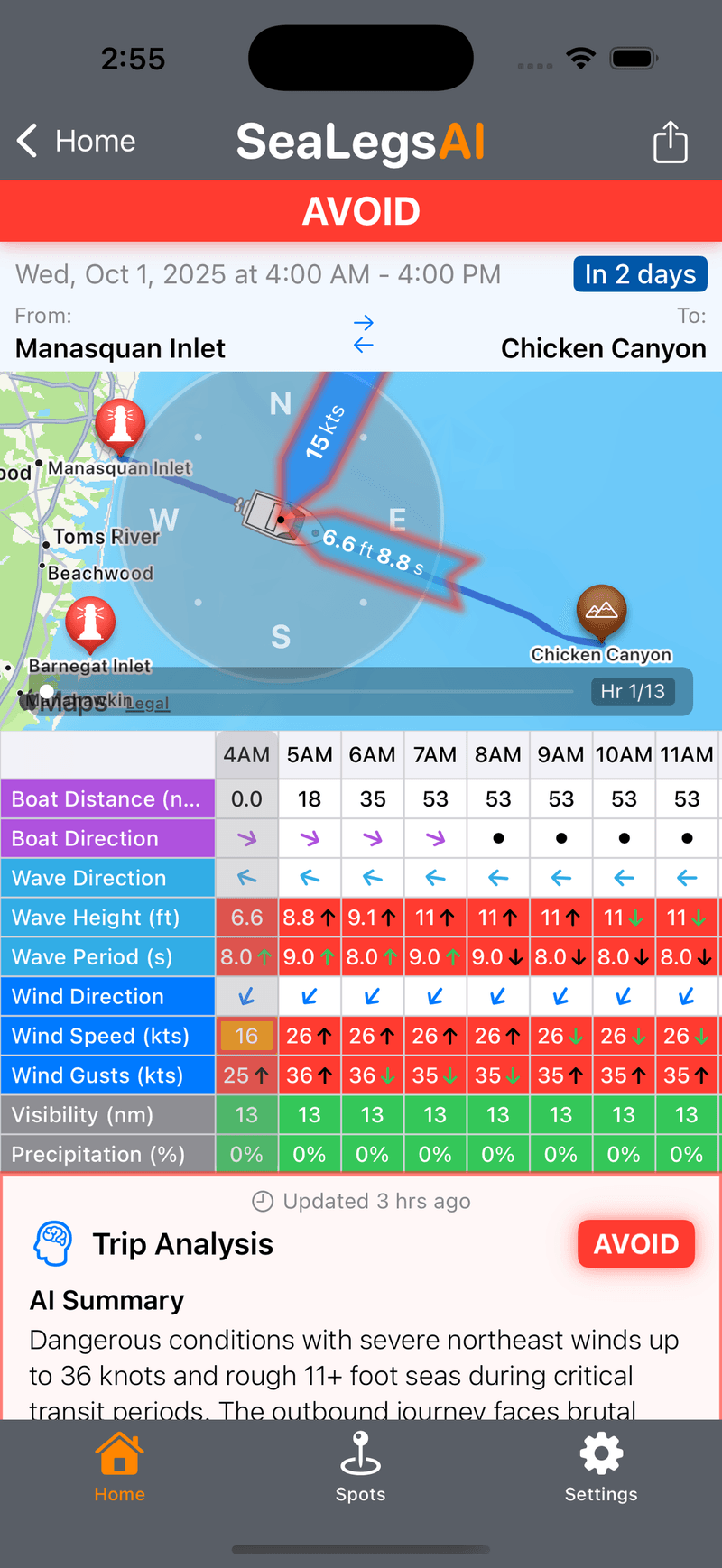
Most of the failure here isn't reading the advisory wrong. It's reading only the advisory: a single line of text describing a whole zone for a whole afternoon, when what you need is the wind, seas, period, and tide at your inlet at your departure time.
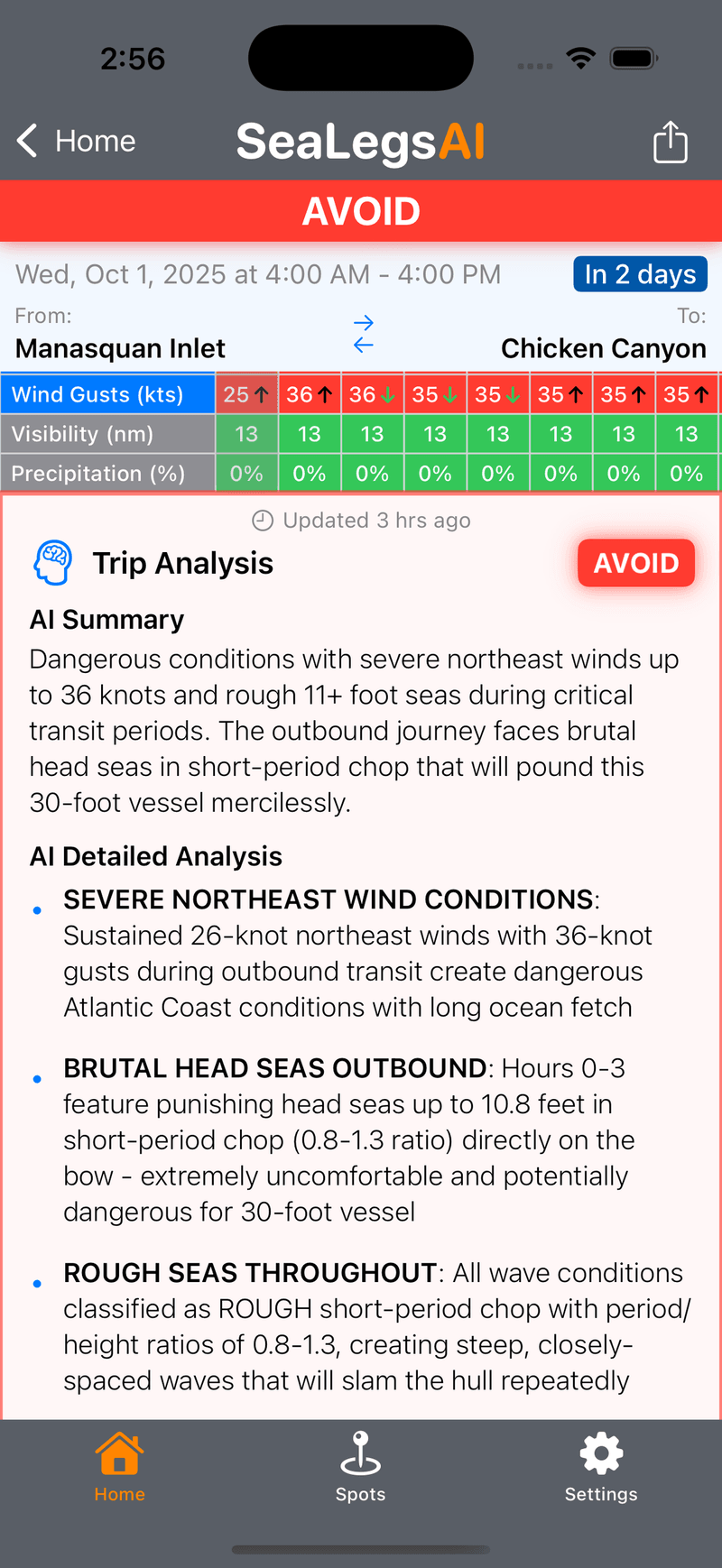
Advisory posted for your zone? Resolve it to your trip.
- Hourly wind & gusts for your exact spot — not the zone average.
- Wave height and period on your route — short-period chop is what flips small boats.
- A clear Go / Avoid call for your departure window, with active NWS alerts inline.
Small craft advisory vs. gale warning
The one comparison worth drawing directly, because it's the next rung and it's a common search:
| Small Craft Advisory | Gale Warning | |
|---|---|---|
| Tier | Advisory | Warning |
| Sustained wind | ~20–33 kt | 34–47 kt |
| Who it's aimed at | Small boats — undefined, your judgment | Essentially all recreational boaters |
| The honest read | A decision | A no |
An SCA asks you a question. A gale warning answers it. If the SCA is the line where judgment matters, the gale is past that line.
A small craft advisory isn't a rule about how big your boat is — it's NOAA telling you the conditions have crossed into decision territory. Read the text, check wind against tide and period at your inlet, and make the call for your trip.