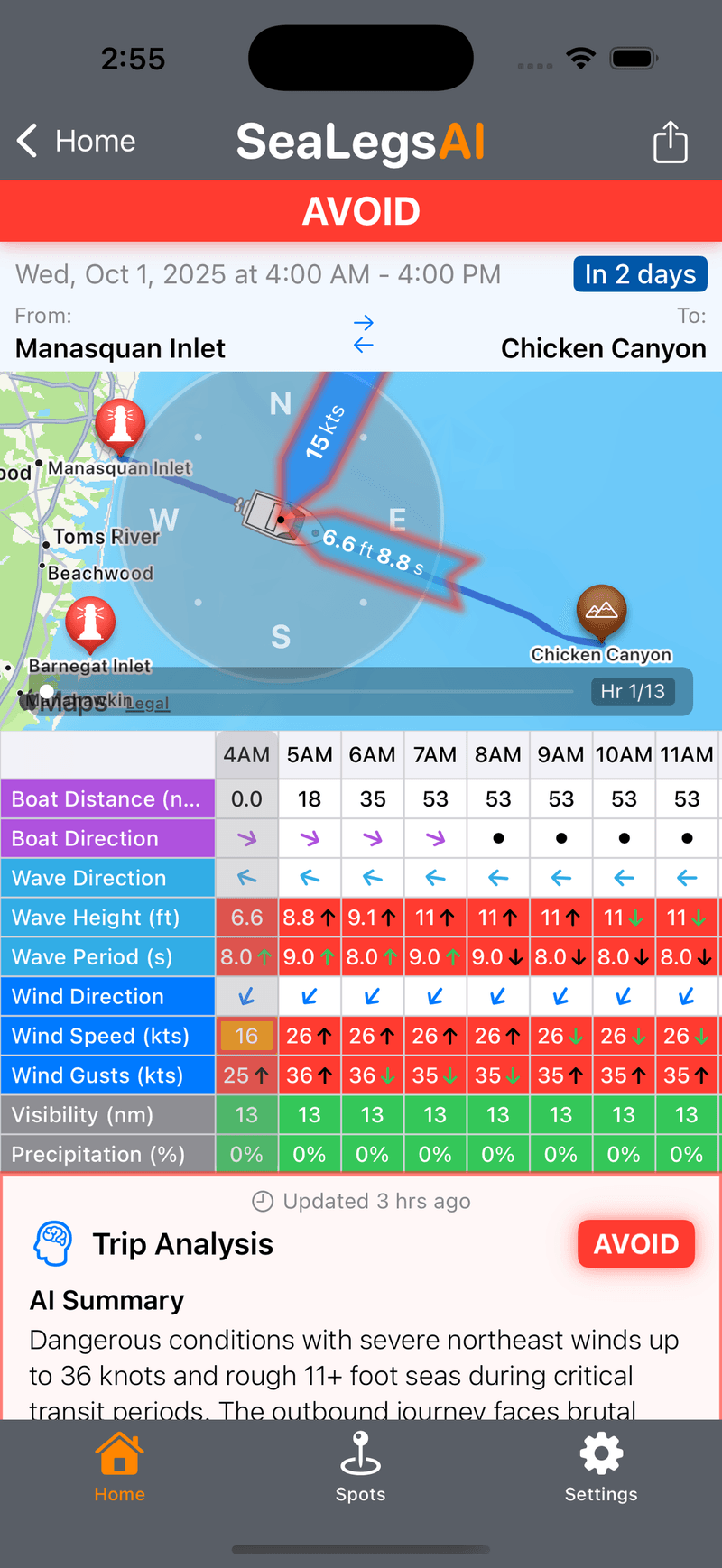
Fetch is the distance of open water the wind blows across in one direction, without land in the way. Along with how hard the wind blows and how long it blows for, fetch is what decides how big the waves get. It's the reason a 20-knot wind can leave a sheltered bay almost flat while the same wind builds dangerous seas on an open coast a few miles away.
It's also the most useful word in the marine forecast that almost nobody explains. Once you understand fetch, wind direction stops being trivia and becomes the single best predictor of where the water will be rough — and where it'll be calm.
The three ingredients of every wave
Wind-driven waves are built from three things working together. Change any one of them and the sea state changes:
| Ingredient | What it means |
|---|---|
| Wind speed | How hard the wind blows. More energy available to push into the water. |
| Duration | How long the wind has been blowing from that direction. Waves need time to build. |
| Fetch | The distance of open water the wind crosses before it reaches you. More distance, more wave growth. |
Most boaters watch only the first one. But wind speed alone can't tell you the sea state, because a strong wind over a short fetch is often calmer than a moderate wind over a long one. The wind is the engine; fetch and duration decide how much of that engine actually reaches the water you're floating on.
How fetch builds — and limits — waves
As wind blows across open water, it hands energy to the surface. The farther it blows, the more energy goes in, so the waves grow taller, longer, and more spaced out. Short-fetch water is steep, messy chop; long-fetch water is the bigger, more organized swell you feel offshore.
Here's the same 20-knot wind across very different fetches:
| Setting | Fetch | Sea state in a 20-kt wind |
|---|---|---|
| Water just off an upwind shore | A few hundred yards | Near flat — ripples |
| A bay or sound | A few miles | Short, steep chop |
| A large lake or open bay | 20–50 miles | Building, uncomfortable seas |
| Open coast / offshore | Hundreds of miles | Large, fully developed seas |
This is why wave height and period change so much from one part of your trip to the next even when the wind reading on your instruments never moves. The wind is constant; the fetch is not.
Fetch-limited vs. fully developed seas
Waves don't grow forever. For any given wind speed there's a ceiling — the biggest the sea can get if the wind blows long enough over enough water. That's a fully developed sea. Below the ceiling, the sea is fetch-limited: the wind could build bigger waves, but it runs out of open water first.
- Fetch-limited — bays, sounds, lakes, and the water downwind of a shoreline. The distance caps the waves, so the sea stays smaller and choppier than the open ocean.
- Fully developed — the open coast and offshore, where the fetch is long enough that the waves reach the maximum size for that wind speed and stop growing.
That distinction is the practical heart of fetch: it tells you whether the water around you has room to get worse, or whether it's already as big as this wind can make it.
Heading out in a building wind? Check these 3 things first.
- The wind direction for your window — it decides which water has fetch and which is sheltered.
- Wave height and period on your route — short-period, fetch-built chop is what beats up small boats.
- A clear Go / Caution / Avoid call for your exact spot and the time you're heading out.
Using fetch to find calmer water
Once you think in fetch, you can read a chart and a wind direction together to predict the ride before you leave the dock:
- Find the upwind shore. Water tucked close to the shore the wind is blowing from has almost no fetch — it stays calm even in a stiff breeze. That's an offshore wind, and it's why the windward shore is the classic shelter.
- Watch the open runs. Wherever the wind has a long, unobstructed reach before it gets to you — an open coast with an onshore wind, the downwind end of a big lake — that's where the seas will be biggest.
- Mind the islands and headlands. The lee of an island, a point, or a breakwater shortens the fetch and flattens the water behind it. Round that point into open water and the fetch — and the waves — can jump suddenly.
An offshore wind means short fetch and calm water near shore that builds as you head out. An onshore wind means long fetch and seas that are already up when you reach open water. Same wind speed, opposite ride — the difference is fetch.
Reading fetch in a real forecast
The hard part is that fetch isn't a single number you can look up. It depends on the wind direction, the shape of the coastline, and where exactly you'll be — which is why a zone forecast that says "winds 20 knots, seas 2 to 4 feet" can be flat-calm at your launch and miserable a mile offshore.
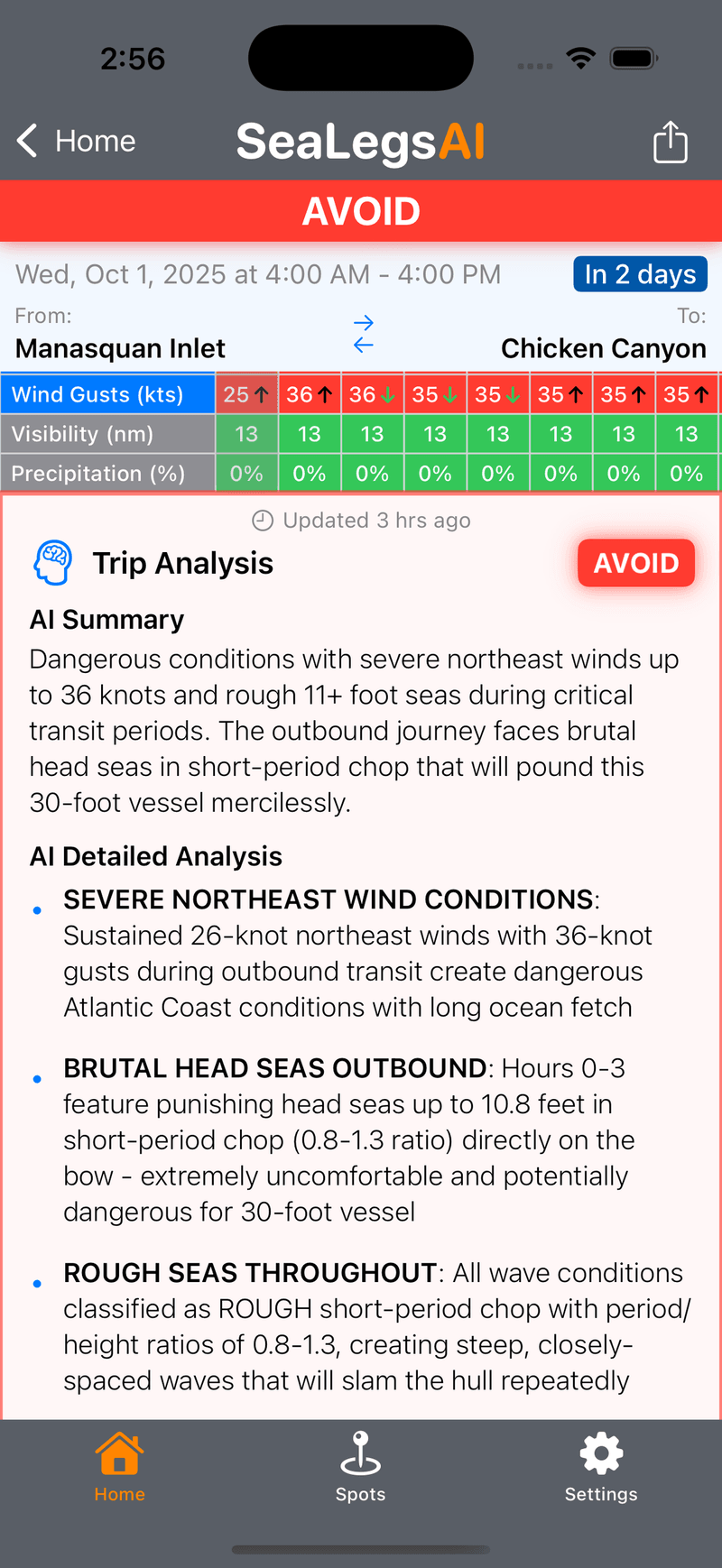
SeaLegs AI does that work for you. Instead of a broad zone average, it pulls point-specific wind, gust, wave height, and wave-period forecasts for your exact spot and departure time, accounting for how the wind and the surrounding water actually interact there — then turns it into a plain Go, Caution, or Avoid call. The forecast tells you the wind; SeaLegs tells you what that wind is going to do to the water under your boat.
The bottom line
- Fetch is the distance of open water the wind blows across — one of the three ingredients of wave size, alongside wind speed and duration.
- The longer the fetch, the bigger and longer the waves, until the sea is fully developed for that wind speed and stops growing.
- A fetch-limited sea (bays, lakes, near an upwind shore) stays smaller and choppier; a fully developed sea (open coast, offshore) is as big as the wind can build.
- Wind direction is your fetch map: offshore wind = short fetch and shelter near shore; onshore wind = long fetch and bigger seas offshore.
- A point forecast beats a zone average because fetch changes from spot to spot — the same wind, very different water.