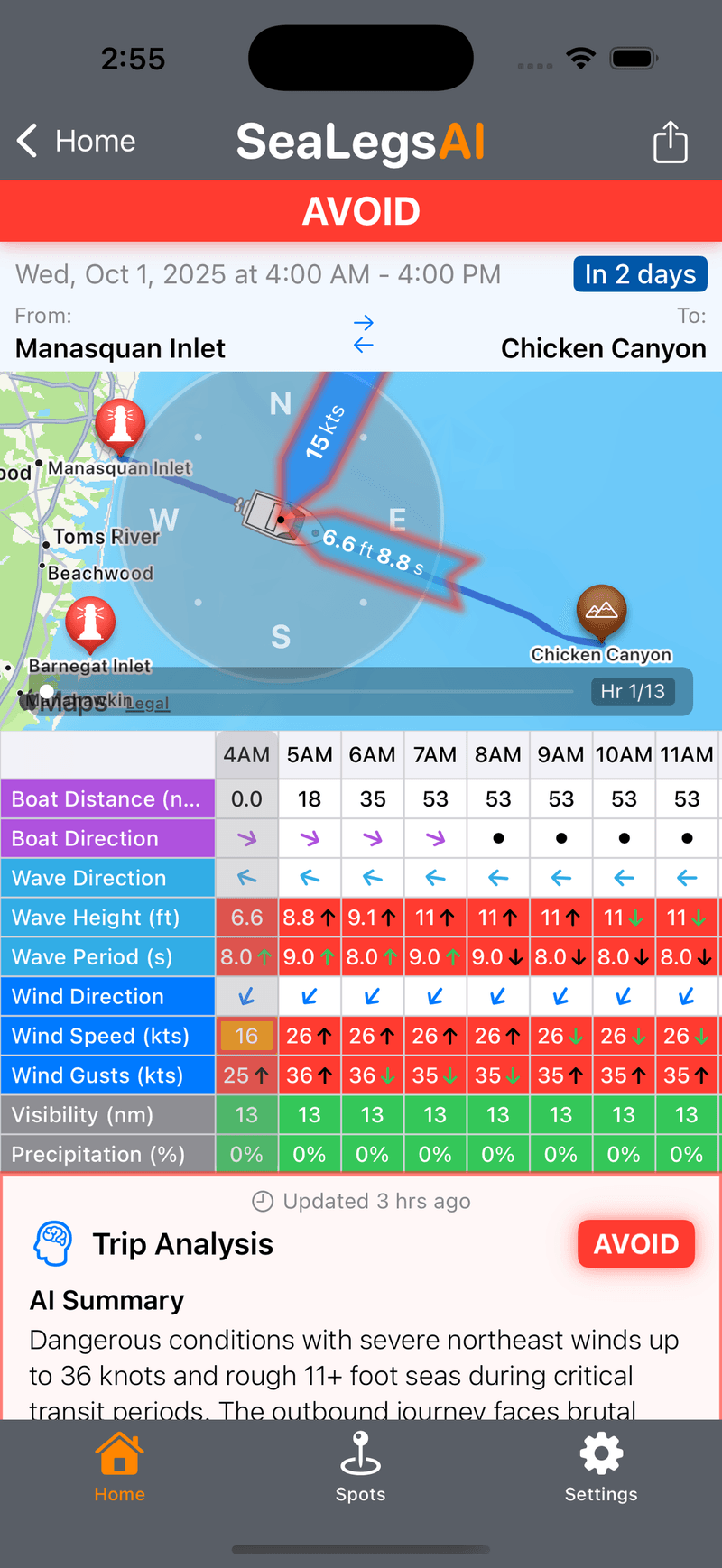


Ask ten anglers what the best barometric pressure for fishing is and you'll get ten charts, a couple of arguments, and at least one person who swears the bite dies the second the needle moves. There's a signal buried in all of it — but it's not the one most articles sell you. The number on the barometer matters far less than which way it's moving and how fast. This guide gives you the honest version: what the science actually supports, the folklore chart with real numbers, and a decision rule you can use tonight before tomorrow's trip.
The short answer
- The best fishing usually comes on a rapidly falling barometer — the hours before a low-pressure front arrives. Fish tend to feed hard in that window.
- A steady, moderately high barometer (around 30.0 inHg / 1016 hPa) is a solid, average day.
- A deep, entrenched low (below about 29.6 inHg / 1002 hPa) after the front has settled in usually means a slow bite — fish drop deeper and get lethargic.
- The trend beats the absolute number every time. A barometer at 30.1 and dropping is a very different day from 30.1 and climbing.
Fish the front coming in, not the front sitting on top of you.
Why pressure affects fish at all — the honest mechanism
Most articles jump straight to the swim bladder. Here's the careful version.
Bony fish have a gas-filled organ called a swim bladder that controls their buoyancy — it lets them hold a depth without constantly swimming. The popular theory is that when atmospheric pressure drops, the reduced pressure lets that bladder expand slightly, the fish feels off-balance, and it gets uncomfortable enough to change depth or stop feeding.
It's a reasonable story, and it's probably part of the picture — but there are no conclusive studies proving it, and there's a strong physics counterargument worth understanding:
Water is roughly 800 times denser than air. A fish that moves just a few feet up or down in the water column experiences a pressure change far larger than the swing from a passing weather front. If a two-foot depth change didn't bother it, why would a slow atmospheric drop?
So what's really going on? The most defensible read is that the barometer is a proxy, not a cause. Falling pressure reliably signals an incoming front — and a front brings changing light, wind, water movement, and bait behavior. Fish likely respond to that whole package of change, with the pressure drop as the early-warning bell. That's why “falling barometer = good fishing” holds up in practice even though the pure swim-bladder mechanism is shaky. You're not reading the fish's discomfort; you're reading the weather that's about to change their world.
This matters for how you use it: don't chase an exact magic number. Watch the direction and the speed of the change.
The “fisherman's barometer” chart — folklore with real numbers
Anglers have used a rule-of-thumb scale for generations. Treat it as a starting point, not a law of physics — but the numbers are worth knowing because the pattern behind them is real.
| Barometer reading | Trend | What anglers typically see |
|---|---|---|
| High — above ~30.2 inHg / 1023 hPa | Steady/rising | Bright, clear, high-sky days. Fish often move deeper or into cover; slower, more finesse-driven bite. |
| Moderate/steady — ~29.8–30.2 inHg / 1009–1023 hPa | Steady | The “average day.” Normal patterns, normal presentations. |
| Falling fast — from high toward a low | Dropping quickly | The prime window. Fish feed aggressively ahead of the front — often the best few hours of the week. |
| Low — below ~29.6 inHg / 1002 hPa | The front has arrived / entrenched | Slow. Fish are deep and lethargic; downsize, slow down, or wait it out. |
| Rising — right after a low clears | Climbing | Often still slow at first; the bite usually rebuilds as conditions stabilize. |
Normal sea-level pressure runs roughly 28.5 to 30.5 inHg (965–1033 hPa), centered near 30.0 inHg / 1016 hPa. You'll rarely be reading extremes — which is exactly why the trend is the useful signal, not the raw value.
In the US, pressure is quoted in inches of mercury (inHg). Almost everywhere else, anglers read hectopascals (hPa) or the equivalent millibars (mb) — 1 hPa = 1 mb. Roughly, 30.00 inHg ≈ 1016 hPa. Read whichever your local forecast uses; the trend logic is identical.
Not all fish care equally
Swim-bladder size seems to track how much a species reacts to pressure change:
- More affected: fish with large swim bladders — trout, grouper, snapper. These are the species where anglers most often report a pressure-driven shutdown.
- Less affected: fish with small bladders — mahi-mahi, kingfish, barracuda. Minor swings barely register.
- Effectively unaffected: sharks, rays, and some tuna have no swim bladder at all. If you're chasing them, a passing front changes the conditions you fish, but there's no bladder mechanism to slow them down.
Translation: if the barometer is dropping and you had grouper in mind, that's a green light. If it's a slow high-pressure bluebird day, a species that doesn't care about pressure may be the smarter target.
A decision rule you can actually use
Forget memorizing the chart. Use the trend:
- Check the barometer trend, not just the number. Look at where pressure was 6–12 hours ago versus now. Direction and speed are the whole game.
- Falling fast ahead of a front? Go — and go early. That pre-front window is often the best of the week. Fish faster, brighter, more aggressive presentations while the feed is on.
- Deep low sitting overhead? Adjust or wait. Slow down, downsize, fish deeper and tighter to structure — or save it for the rebuild.
- Steady and moderate? Fish your normal patterns. No edge to press, no reason to stay home.
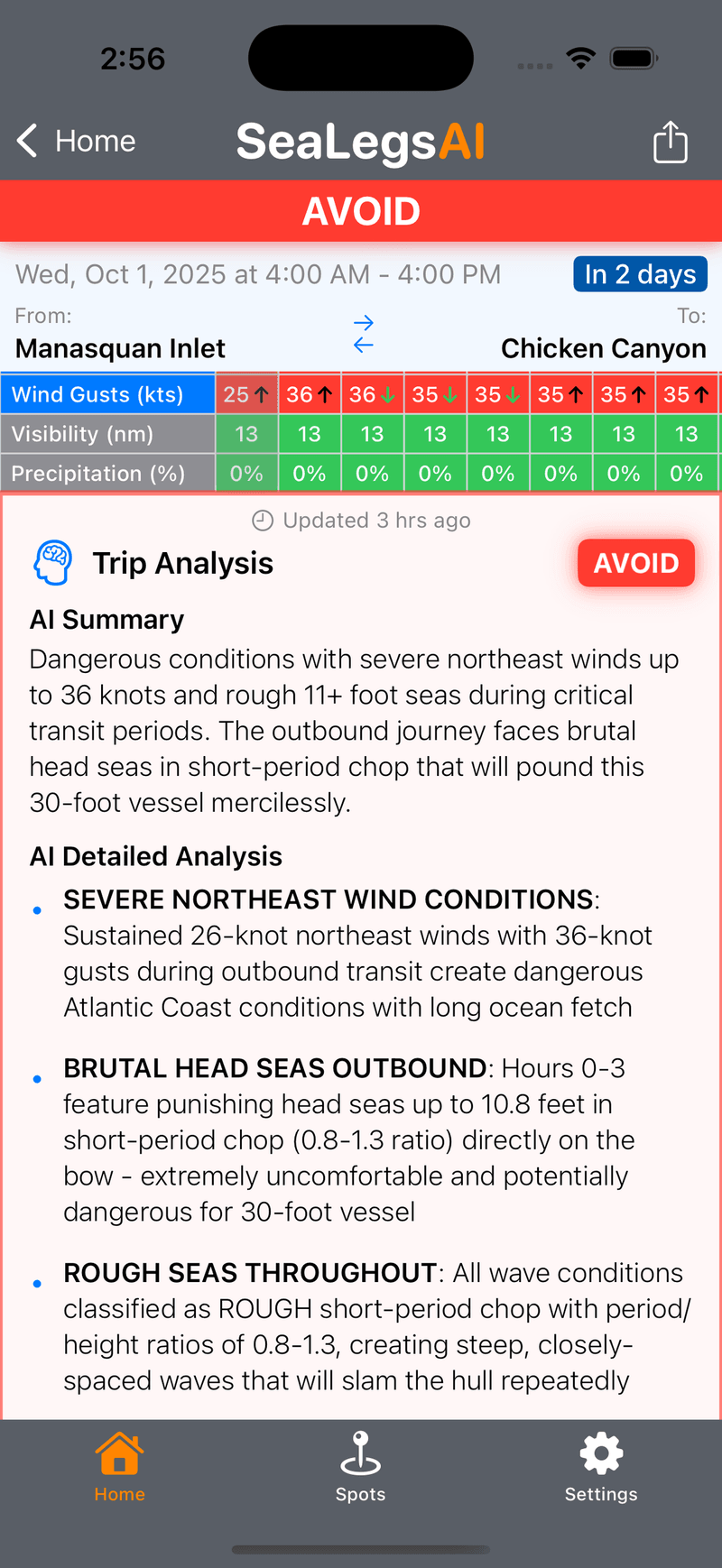
- Cross-check the front, not just the needle. A falling barometer that comes with a small craft advisory or building seas is a safety call, not just a fishing one — the same front that turns the bite on can make the run out dangerous. Read the wind and sea-state forecast and the advisory status before you commit.
See the pressure trend, not just today's number
- Hour-by-hour pressure trend for your spot — is it falling, and how fast?
- Water temperature, wind, and sea state in the same read, so you see the whole front.
- A plain-language call on the window — and whether the run out is safe.
Where pressure fits in the bigger picture
Barometric trend is one signal, not the whole forecast. It's one of the six signals every angler should read before a trip — alongside wind, water temperature, tide/current, light, and sea state. The anglers who consistently do well aren't reading a single magic number; they're reading how those signals line up.
That's the whole idea behind DeepCast — instead of eyeballing a barometer and guessing, it pulls the pressure trend together with water temperature, wind, and sea state for your exact spot and window, so “is the barometer doing something worth fishing?” becomes part of a single read instead of a hunch. You still make the call — you just make it with the front, the water, and the trend all in one place.