

Almost every guide to preventing seasickness starts in the same place: a list of pills, patches and wristbands. Those have their place. But by the time you're reaching for them, you've already made the decision that mattered most — which day you went out.
Seasickness is a conditions problem before it's a pharmacy problem. Two boats can leave the same harbour in the same forecast “3-foot seas” and have completely different days aboard, because 3 feet doesn't describe how the boat is going to move. This guide covers the ten things that genuinely work, starting with the one most people never check.
The short answer
- Pick your day on wave period, not just wave height. Short, steep chop makes far more people sick than a bigger, slower swell.
- Get on deck and find the horizon. Below deck is the worst place on the boat.
- Stay amidships and low — the middle of the boat moves least.
- Take the helm if you can. The person steering is almost never the person being sick.
- Try one earplug in your non-dominant ear — an old sailor's trick that works far better than it has any right to.
- Act early. Every one of these works far better before you feel bad than after.
A 3ft sea at 4 seconds will empty more stomachs than a 5ft swell at 11 seconds. Check the period.
Why you get seasick — and why it isn't weakness
Seasickness is a sensory conflict. The balance organs in your inner ear report that you are being thrown around in three dimensions. Your eyes, meanwhile, are looking at a cabin bulkhead or a phone screen that appears perfectly still. Those two reports don't agree, and your brain responds to the disagreement by making you feel deeply unwell.
That's the whole mechanism, and it explains why nearly every effective remedy is really doing one of two things: reducing the motion your inner ear has to deal with, or giving your eyes something that agrees with it.
It also explains why susceptibility says nothing about how tough or experienced you are. Plenty of career mariners get sick in a confused cross-sea. NOAA's National Ocean Service notes the same basic conflict mechanism — this is physiology, not character.
The part most guides skip: it's the period, not the height
Ask a forecast how big the waves will be and you'll get a number in feet or metres. That number alone is close to useless for predicting how sick your crew will get.
What actually determines the ride is wave period — the number of seconds between one crest and the next. Period tells you how steep the water is and how violently the boat has to respond to it:
| Sea state | What the boat does | Seasickness risk |
|---|---|---|
| 3 ft at 4 seconds | Short, steep, stacked chop. Constant sharp pitching and slamming with no rhythm. | High — the classic crew-wrecker |
| 3 ft at 9 seconds | Long, gentle rollers. The boat rises and settles predictably. | Low |
| 5 ft at 11 seconds | Bigger water, but slow and spaced out. Often a comfortable ride. | Low to moderate |
| Two swells from different directions | Confused, cross sea. Irregular corkscrew motion with no pattern to anticipate. | Highest — worse than either swell alone |
The rough guide most boaters use: if the period in seconds is less than about twice the wave height in feet, expect an uncomfortable, choppy ride. When the period is well above that, the same height feels like a completely different ocean.
That confused cross-sea in the last row deserves special mention. When a fresh wind sea runs across an older ground swell, the boat's motion becomes genuinely unpredictable — and unpredictable motion is what your inner ear handles worst. Your body can partly brace for a rhythm. It cannot brace for randomness. We've written up the full picture in wave height vs period if you want the detail.
Before you go: three decisions that do the heavy lifting
1. Choose the day on period and swell direction. If you have any flexibility at all, this is the single highest-leverage move available to you. Shifting a trip by one day to catch a longer period is worth more than everything else on this list combined.
2. Check wind against tide. This is the one that catches people out. When wind blows against a running tide or current, waves stop stretching out and stack up short, steep and close together — precisely the motion that makes people sick. The same 15 knots that gives you a comfortable ride running with the current can produce a genuinely miserable one running against it, and it bites hardest in inlets, channels and tidal races. Look at which way the current sets during your window, not just at what the wind is doing.
3. Sleep, hydrate, and go easy the night before. Fatigue, dehydration and a heavy night out all lower your threshold considerably. Eat something bland before you board rather than nothing at all — an empty stomach is not protective, and being hungry on the water makes everything worse.
See the period, not just the height
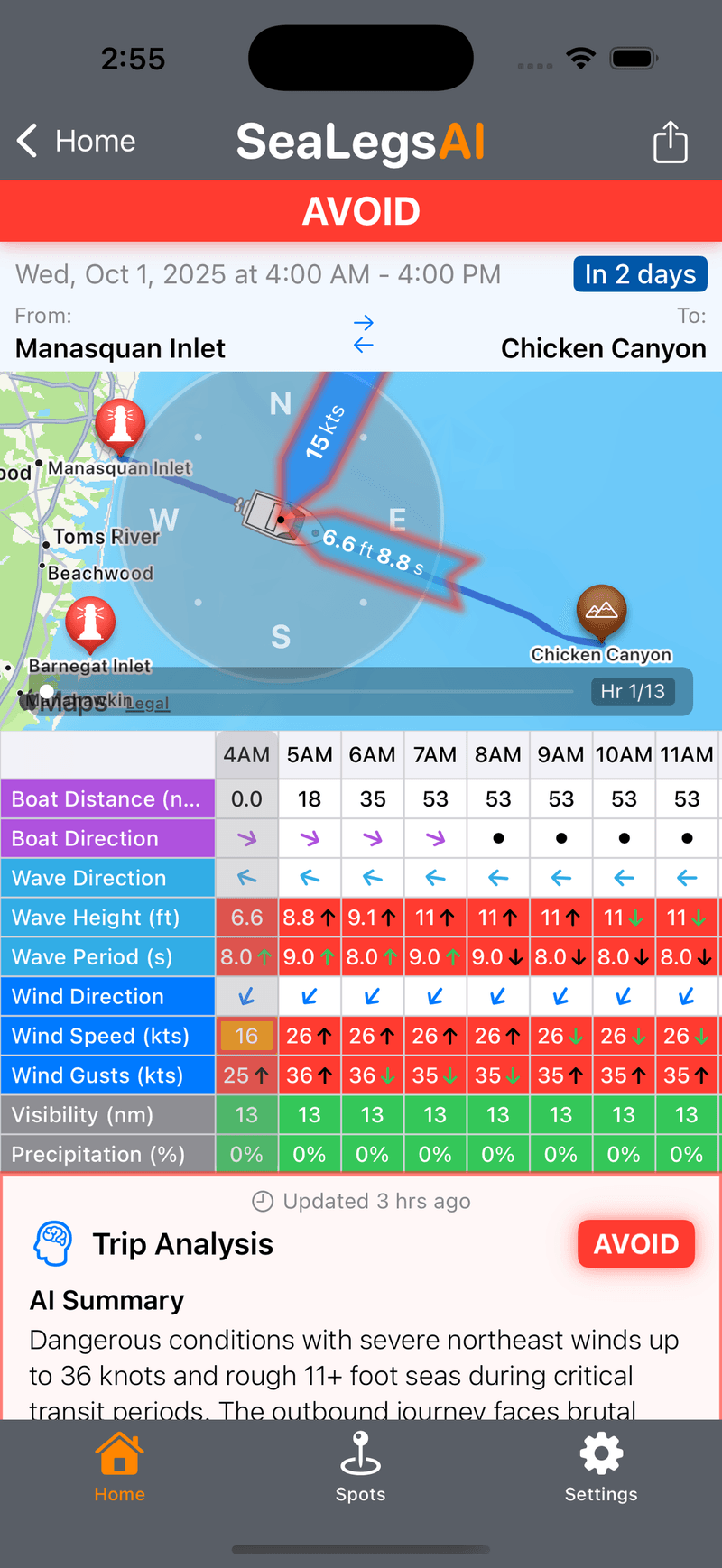
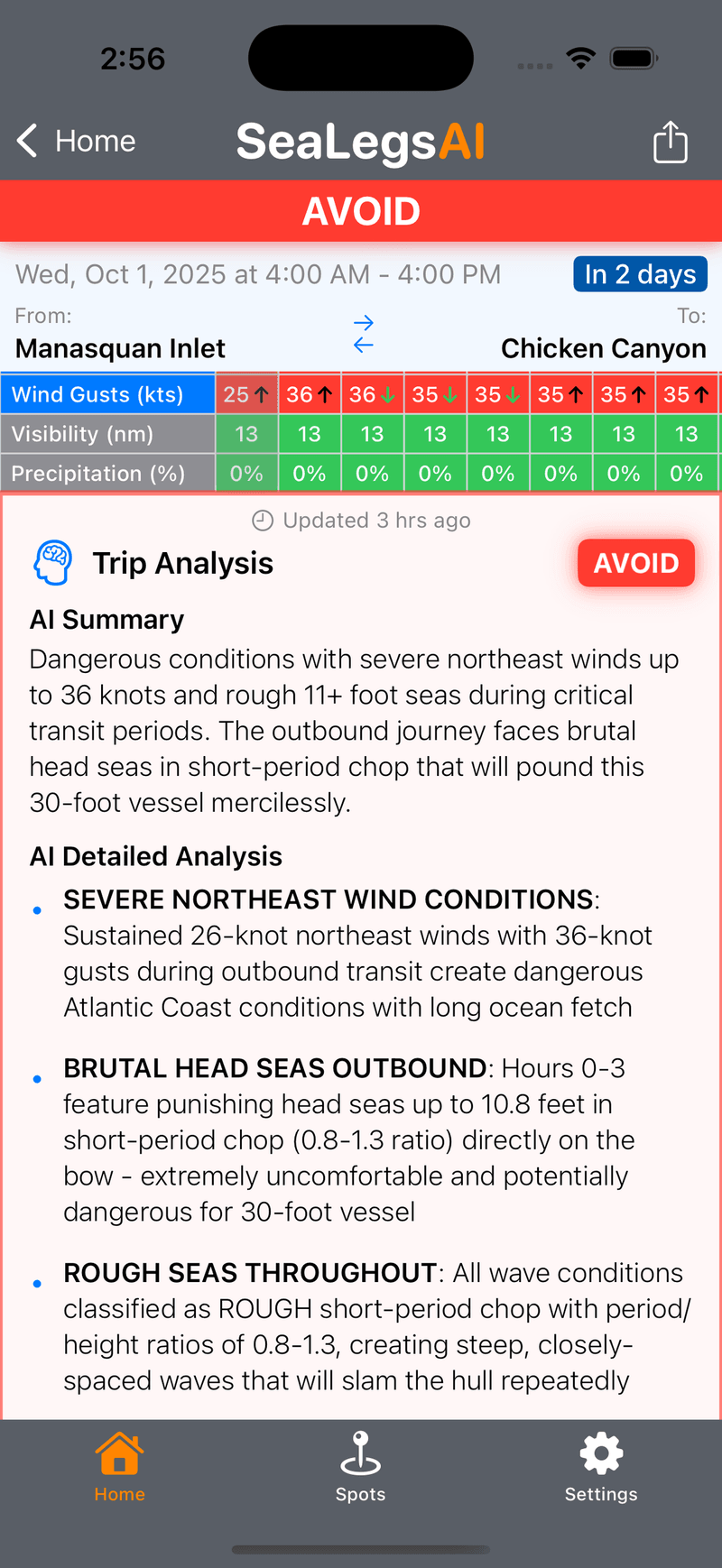
- Wave height and period together for your exact spot — so you can spot the steep days before you commit.
- Swell direction and wind, so you can see a confused cross-sea forming.
- A plain-language GO / CAUTION / NO-GO call on the window you're considering.
On board: six things that work
4. Get on deck and lock onto the horizon. This is the cheapest and most effective thing you can do. A fixed, distant horizon gives your eyes a stable reference that finally agrees with what your inner ear is reporting. The conflict drops, and so does the nausea.
5. Take the helm. There's a reason the skipper rarely gets sick. Steering means you're constantly looking ahead at the horizon and anticipating the next wave — and motion you predict affects you far less than motion that simply happens to you. If you can't steer, sit facing forward where you can see what's coming.
6. Stay amidships and low. A boat pitches around a point near its centre, so the bow and stern swing through the biggest arcs while the middle stays comparatively settled. On a small boat that might be a foot or two of difference; on a bigger one it's dramatic. To be clear, low means lower down but still out on deck — not below. Going below is the worst move available to you.
7. Get cool air on your face. Fresh moving air genuinely helps, and stuffy or fume-heavy spaces genuinely hurt. Diesel exhaust, a hot galley, or the smell of yesterday's bait will start a queasy person down the road quickly.
8. Keep sipping and keep nibbling. Small amounts of water and plain, dry food — crackers, bread, plain biscuits — sit far better than either an empty stomach or a big greasy meal. Go easy on alcohol and heavy coffee.
9. Put the phone down. Reading, scrolling, staring at a chart plotter, or fiddling with a camera all force your eyes to focus on something fixed and close while the boat throws you around. It is one of the fastest ways to make a marginal situation acute. If you must look at a screen, do it in short bursts, standing up, with the horizon in view.
Every tip here works dramatically better as prevention than as cure. Once nausea properly sets in, the horizon and the fresh air help much less. Move to the rail, into the air, and onto the helm at the first hint — not when you're already committed.
10. The one-earplug trick
This one sounds like folklore and gets left out of almost every seasickness guide, which is a shame, because plenty of sailors rate it as the single most effective thing they've ever tried. It costs about a pound, weighs nothing, and takes five seconds.
Put one earplug in your non-dominant ear. Leave the other ear completely open.
- Right-handed? Plug the left ear.
- Left-handed? Plug the right ear.
The reasoning goes back to the sensory conflict we started with. Your nausea comes from your inner ear and your eyes filing contradictory reports. Muffle one ear and you deliberately degrade one of those two signals — the brain notices that the balance information arriving from your ears has gone lopsided and unreliable, quietly stops trying to reconcile it, and defaults to trusting your eyes instead. No conflict, no nausea. You're not blocking the motion; you're settling the argument.
One plug, not two. Plugging both ears just muffles your hearing and removes the asymmetry that makes the trick work in the first place. A cheap foam plug is fine. Many people report it working within a few minutes even after symptoms have started — which makes it one of the very few items on this list that's genuinely useful as a rescue as well as a preventative.
Fair warning on the evidence: this is a long-standing practical remedy passed between sailors, not a clinically proven treatment, and it doesn't work for everyone. But it has no side effects, costs almost nothing, doesn't make you drowsy the way some medications can, and you can test it on your next trip at essentially zero risk. For a technique with that risk profile, “plenty of people swear by it” is a good enough reason to keep a pair in the boat.
If it starts anyway
You're not out of options. Get out of any enclosed space and into moving air. Get your eyes onto the horizon and keep them there. Move toward the middle of the boat, sit or lie down low and facing forward, loosen anything tight, and keep taking small sips of water — dehydration from being sick makes the whole thing worse and lingers long after you're back ashore.
If you're genuinely struggling, tell the skipper rather than toughing it out quietly. A course change to put the seas on a kinder angle, or a slight speed change to stop the boat slamming into a short period, can transform the motion within minutes. Most skippers would far rather adjust the ride than deal with the alternative.
Prolonged vomiting causes real dehydration, and a badly incapacitated crew member is a safety issue, not just an unpleasant one — particularly offshore or shorthanded. If someone can't keep fluids down, becomes confused, or can't function, treat it as a reason to head in. For medication, ask a pharmacist or your doctor before the trip; most options work best taken well in advance rather than after symptoms start.
Getting your sea legs — yes, we hear ourselves
We named the company after the expression, so feel free to take this section with an appropriate pinch of sea salt. But “getting your sea legs” isn't just a nautical figure of speech someone embroidered on a cushion. It describes something real and measurable — and it's genuinely the most encouraging fact in this whole article.
Given consistent motion, your brain stops treating the conflict as an emergency and recalibrates around it. For most people that adaptation takes roughly two to three days of continuous exposure. The nausea fades, your balance quietly reorganises itself, and one morning you notice you're carrying two coffees across a moving deck without thinking about it. That's it. That's the whole legendary phenomenon — your brain finally filing the motion under “normal.”
The catch, and it's a genuinely annoying one: it's perishable. Spend a week or two ashore and you'll hand a good portion of it back, then re-adapt on the next trip. Which is the real reason the tenth trip is easier than the first — not grit, just repetition.
So if your first offshore day was miserable, that's not a verdict on you as a boater. It's a completely normal first outing, and it gets better. It gets better faster if you stack the deck in your favour on day one by picking a long-period day, staying on deck, and taking a turn at the wheel.
Which is, in the end, the whole point of what we build. SeaLegs AI reads wave height, period, swell direction, wind and sea state together for your exact spot and window, and tells you in plain language whether it's a GO, a CAUTION or a NO-GO — so “will this be a rough one?” is something you know before you leave the dock, instead of something you find out an hour offshore. Choosing the right day is still the most powerful anti-seasickness tool there is. We just make it a lot easier to find it.