The short answer
The maestrale — known in French as the mistral — is the cold, dry wind that blows from the northwest across the western Mediterranean. It forms behind cold fronts, when polar air pours down the Rhône valley and squeezes between the Massif Central and the Alps, and it reaches open water already at speed — over the Gulf of Lion, Corsica, Sardinia, and the western Tyrrhenian Sea. The name comes from the Latin magistralis: the "master wind", the one that runs the compass rose of the northwestern Mediterranean.
Among sailors and boaters it has earned a double reputation: it is the wind that scrubs the sky clean — crisp days, dry air, spectacular visibility — and at the same time one of the winds that builds a sea faster than almost any other. That deceptively sunny day with whitecaps to the horizon is, more often than not, a maestrale day.
Why it happens
The maestrale is a post-frontal wind: it arrives after a cold front passes, not before. The mechanism repeats itself almost identically every time:
- A low-pressure system moves over the Mediterranean — typically the Gulf of Genoa or the Tyrrhenian — while high pressure builds in behind it from France or the Atlantic.
- A strong pressure gradient forms between the two, and cold air of polar or arctic origin starts flowing south.
- The terrain acts as a funnel. The descending air can't easily climb over the Massif Central on one side or the Alps on the other, so it channels down the Rhône valley and exits accelerated over the Gulf of Lion — the same effect as a thumb over a garden hose.
- Over open water the wind fans out and runs southeast: Corsica, the Strait of Bonifacio, Sardinia, and in strong episodes all the way to the Sicilian Channel.
That explains the maestrale's two signatures: the washed-clean sky (the air is cold, dry, and descending, so clouds dissolve) and the gusts (channeled air never arrives smooth; it arrives in packets). A 20-knot maestrale gusting 30 is the norm, not the exception.
Where and when it blows
The maestrale is at home across the western Mediterranean, but not everywhere with the same force:
| Area | What to expect |
|---|---|
| Gulf of Lion | The exit zone: the wind is strongest and most frequent here, with a sea already built offshore. |
| Strait of Bonifacio | The second funnel: the gap between Corsica and Sardinia accelerates the flow again. In a fresh maestrale it is one of the more demanding passages in the Mediterranean. |
| Western Sardinia and Gallura | Fully exposed coast: the sea arrives long and well-formed, built over hundreds of miles of fetch. This is maestrale country by definition. |
| Eastern Sardinia | In partial lee, but with violent downslope gusts near shore and a sea that builds fast the moment you leave the island's protection. |
| Tyrrhenian and peninsular coasts | The wind arrives spread out but still effective: for the coasts of Lazio, Campania, and southern Tuscany it is often the dominant wind on clear, rough days. |
As for the calendar: the maestrale blows year-round. The most violent episodes are winter ones, tied to arctic outbreaks, and can last two or three full days. In summer it is more frequent than people expect — shorter episodes, often reinforced in the afternoon, that ruin the trip of anyone who only read "sunny and clear" in the forecast.
The sea it builds
The part that matters if you're heading out: the maestrale has fetch. From the French coast to Sardinia the wind runs over hundreds of miles of open water, and the waves have all the room they need to grow. The typical result is a northwest sea that is steep and short in the first hours, lengthening as the episode wears on — and that keeps arriving at the coast even after the wind has dropped, as leftover swell.
Three practical readings:
- Don't trust the sky. The maestrale is the wind of gorgeous days. The right question isn't "what's the weather" but "what's the wind, and how long has it been blowing": a maestrale that has run for 24 hours has built a sea the photo of the sky doesn't show.
- Watch the period, not just the height. Five feet at 5 seconds, on the bow, is a sequence of steep walls; the same height at 9 seconds is a different ocean. The why is in the guide to wave height and period.
- Beware the lee that ends. The stretch under the coast can be nearly flat while the sea a few miles out is fully formed. With the maestrale the transition is abrupt: round the cape, or clear the island's shelter, and the real sea arrives all at once.
How to tell the maestrale is coming
The most useful question on the page, because the maestrale announces itself with readable signs:
- The frontal passage. If a cold front has just come through — showers, then a sharp clearing — the maestrale is the prime suspect for the hours that follow.
- The wind shift. The classic entrance is a veer from southwest or west around to northwest, often quick and accompanied by gusty reinforcement.
- Pressure rising fast. A barometer climbing decisively after the low is the sign that high pressure is pushing in from the west: the post-frontal gradient is under construction.
- Cooler, drier air and visibility that explodes. When distant islands and mountains turn sharp "as if cut out", the airmass has already changed.
The signs tell you it's coming. How hard, for how long, and what sea it puts on your stretch of coast — that's a job for a point forecast, not a proverb.
Maestrale or tramontana?
The most common mix-up on the Mediterranean wind rose, because the two are neighbors and often ride the same synoptic setups:
| Maestrale | Tramontana | |
|---|---|---|
| Direction | Northwest | North |
| Character | Cold, dry, gusty, with long fetch over the western Mediterranean | Cold, dry, often a downslope wind off the mountains; a shorter sea near the coast |
| Where it rules | Gulf of Lion, Corsica, Sardinia, western Tyrrhenian | Liguria, upper Tyrrhenian, western Adriatic below the mountain passes |
The maestrale is one of the eight winds of the classical Mediterranean rose — for the full picture (scirocco, libeccio, grecale, tramontana, and the rest) see the guide to the Mediterranean winds.
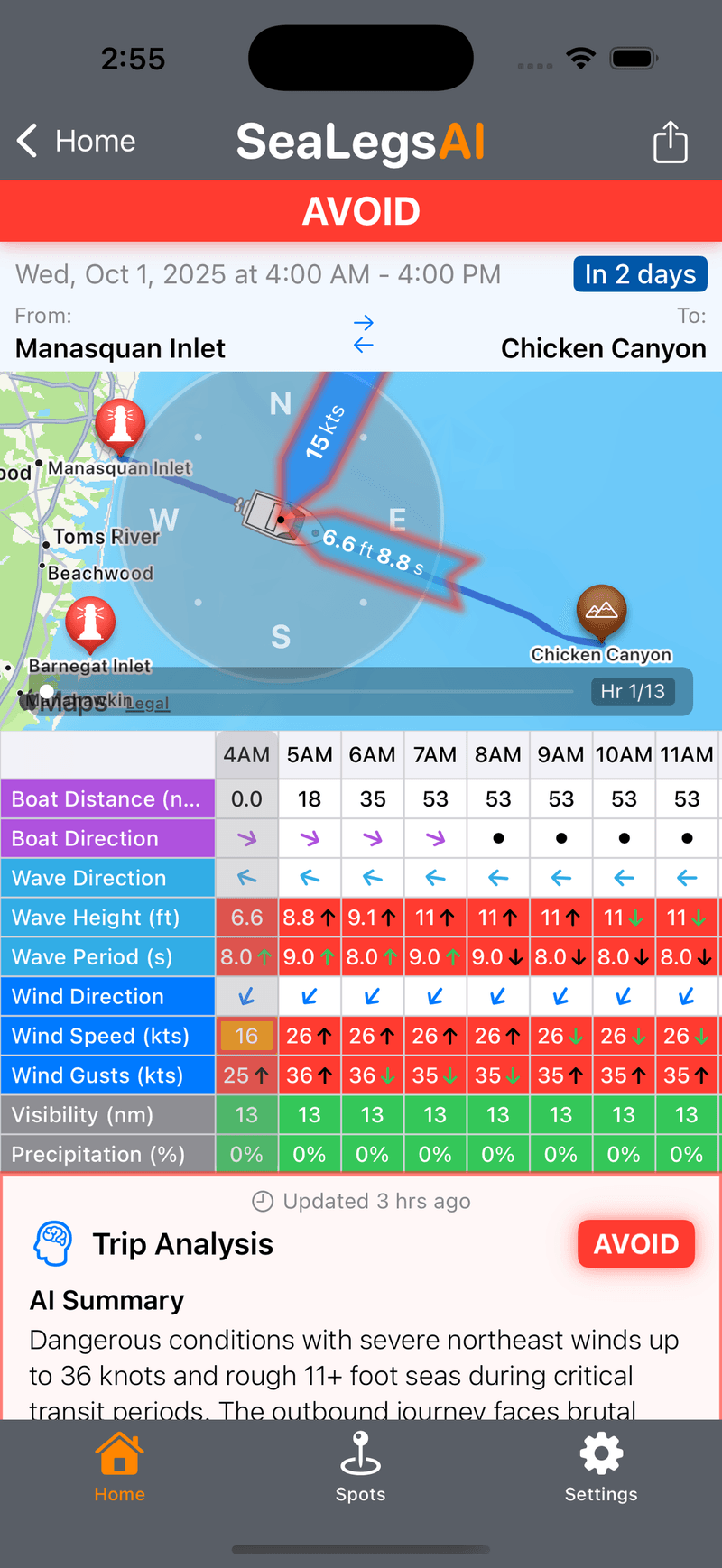
Maestrale on the way? See what it does at your spot.
- Hour-by-hour wind and gusts for your exact spot — not a zone-bulletin average.
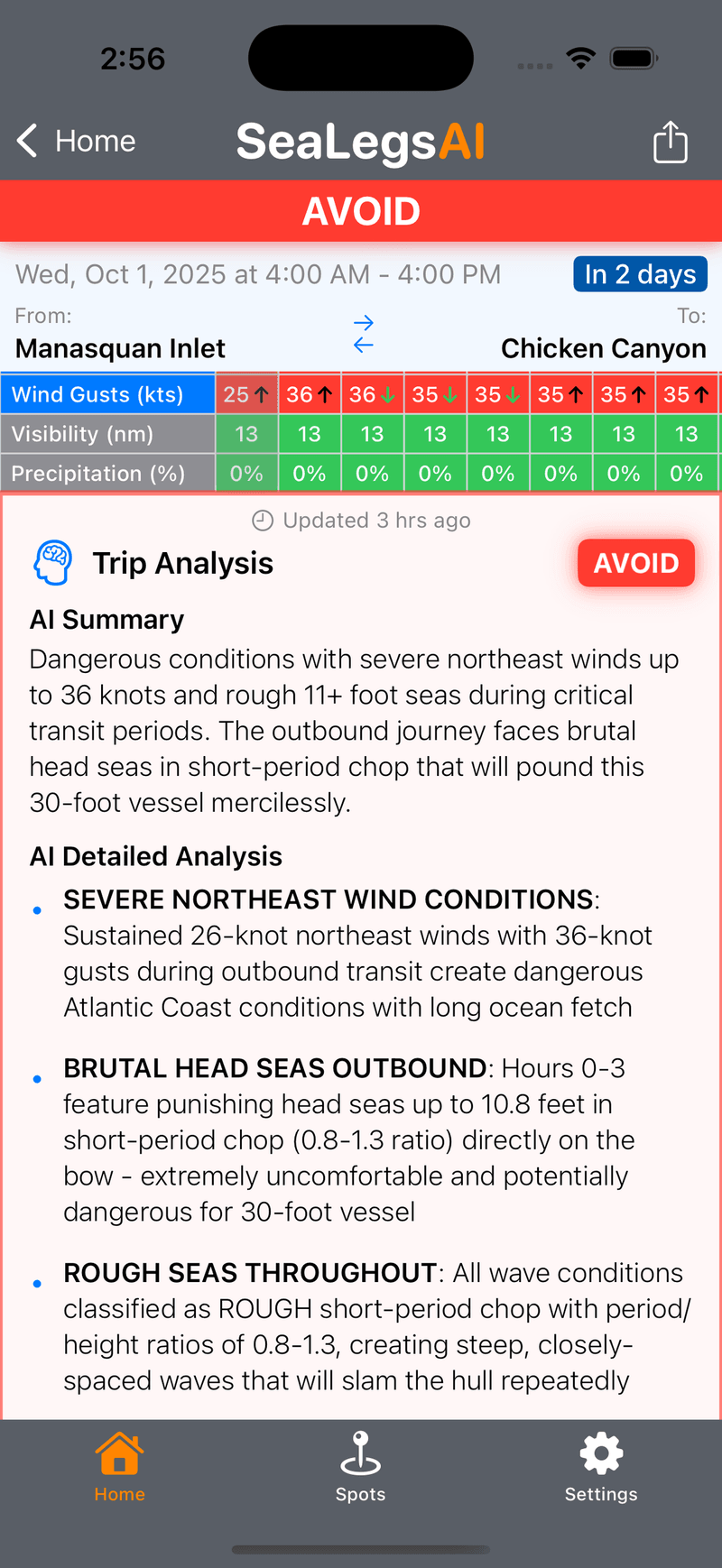
- Wave height and period along your route — the maestrale's short sea is what makes the day hard.
- A clear Go / Avoid verdict for your departure window.
The maestrale is the cold northwest wind that follows the front: clean sky, gusts, and a sea that builds fast and outlasts the wind. Enjoy the visibility — but read the wind, gusts, and wave period at your spot before you drop the lines.