Brazil has nearly 7,500 km of coastline, and the marine weather at one end has almost nothing to do with the other. The northeast runs on the alísios — warm, dependable trade winds. The southeast and south run on cold fronts and the southerly change behind them. Learn the handful of named conditions, and a coast this big becomes far more readable.
This is a boater's tour of what actually decides whether you go: the steady wind that built a kitesurfing industry, the fronts that turn the southern coast over every few days, and the heavy-seas event — the ressaca — that Brazil's Navy issues alerts for.
The alísios: northeast trade winds
Along the Nordeste — Ceará, Rio Grande do Norte and up — the alísios (trade winds) blow from the east, steady and strong. Typical strength is 15 to 30 knots, lighter in the south and reaching 40 knots further up the coast, and they're at their most reliable from about June to December. They follow a daily rhythm: light in the morning, building through late morning and peaking in the mid-afternoon.
That consistency is why the Nordeste — Fortaleza, Cumbuco, Jericoacoara — is one of the world's great kitesurfing and sailing regions. For a boater it means something rarer still: a wind you can plan around with confidence, as long as you respect the afternoon build.
Frentes frias and the vento sul
The southeast and south are a different world, governed by the frente fria (cold front). These fronts sweep up the coast from southwest to northeast; as one passes, the wind shifts hard into the south — the vento sul — the temperature drops, and the seas build quickly.
They're frequent. The coast of Santa Catarina sees roughly three to four cold fronts a month — about one every eight days — with southerly gusts around 30 knots. That's why conditions on the southeast and south coast change so fast: a calm morning can become a 25–30 knot southerly with a building sea by afternoon, much like the Southerly Buster on the other side of the Southern Hemisphere.
Ressaca: Brazil's heavy-seas event
A ressaca is the word every coastal Brazilian knows — a sharp rise in sea level and waves piling onto the shore, strong enough to flood beachfront avenues and tear at the coast. It isn't one thing but a constructive sum of three: wind pushing water against the land, large waves, and the tide.
Because the tide is part of it, ressacas are worst during spring tides (marés de sizígia), around the new and full moon, when tidal range is greatest. On the southeast and south coast they're driven by the south-to-southwest winds of cold fronts, and they're most common in winter and spring, when extratropical cyclones form most often. Brazil's Navy (Marinha) issues ressaca alerts — treat them the way you'd treat any coastal storm warning.
Stay off the water and well back from exposed shorelines, breakwaters, and rock walls. A ressaca's danger isn't only the wave height — it's the elevated sea level on top of a spring tide, which is what puts water where it normally never reaches.
Extratropical cyclones — the engine of the south
The systems behind the worst southern seas are extratropical cyclones (ciclones extratropicais) forming over the South Atlantic. They're the main drivers of high-energy waves on the southern coast, frequently producing seas over four metres, with the largest south of about 35°S.
One reassurance: unlike the North Atlantic or the Australian tropics, true tropical cyclones are very rare in the South Atlantic. The storms you plan around in Brazil are frontal and extratropical — powerful and frequent, but not hurricanes.
The Brazilian coast, region by region
| Region | Defining wind | Watch for |
|---|---|---|
| Nordeste (NE) | Alísios — steady E trade winds, 15–30 kt | Strong afternoon build; stronger further north |
| Sudeste (Rio, São Paulo) | Sea breezes; frontal southerlies | Frente fria, vento sul, ressaca |
| Sul (SC, RS) | Frequent fronts; the vento sul | Cold fronts ~weekly; biggest seas; extratropical cyclones |
Heading out on the Brazilian coast? Check these 3 things first.
- Whether a frente fria is due — the vento sul behind it can build a sea in a few hours.
- Wave height and period for your exact spot — a ressaca is about sea level and swell, not just wind.
- A clear Go / Caution / Avoid call for your launch and the time you'll be on the water.
Reading it before you go
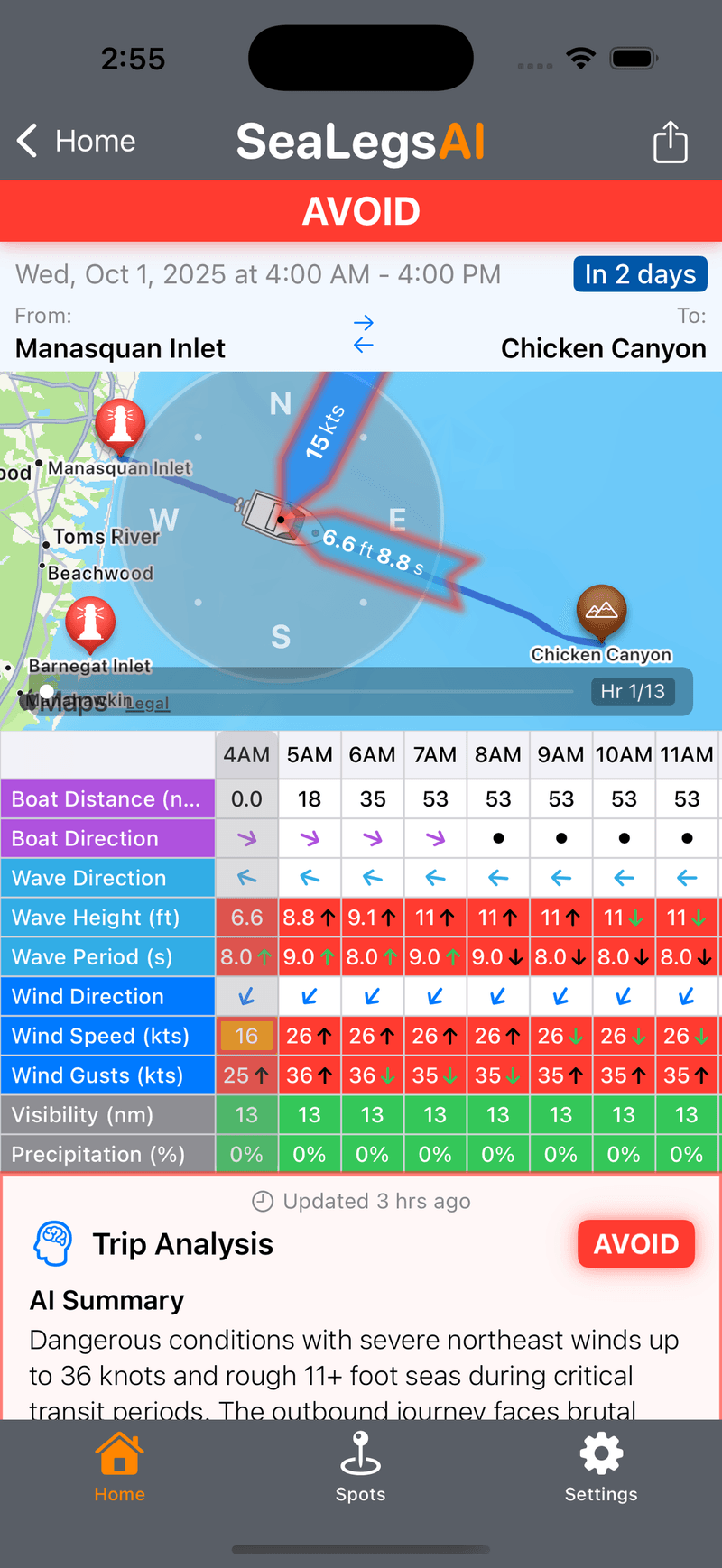
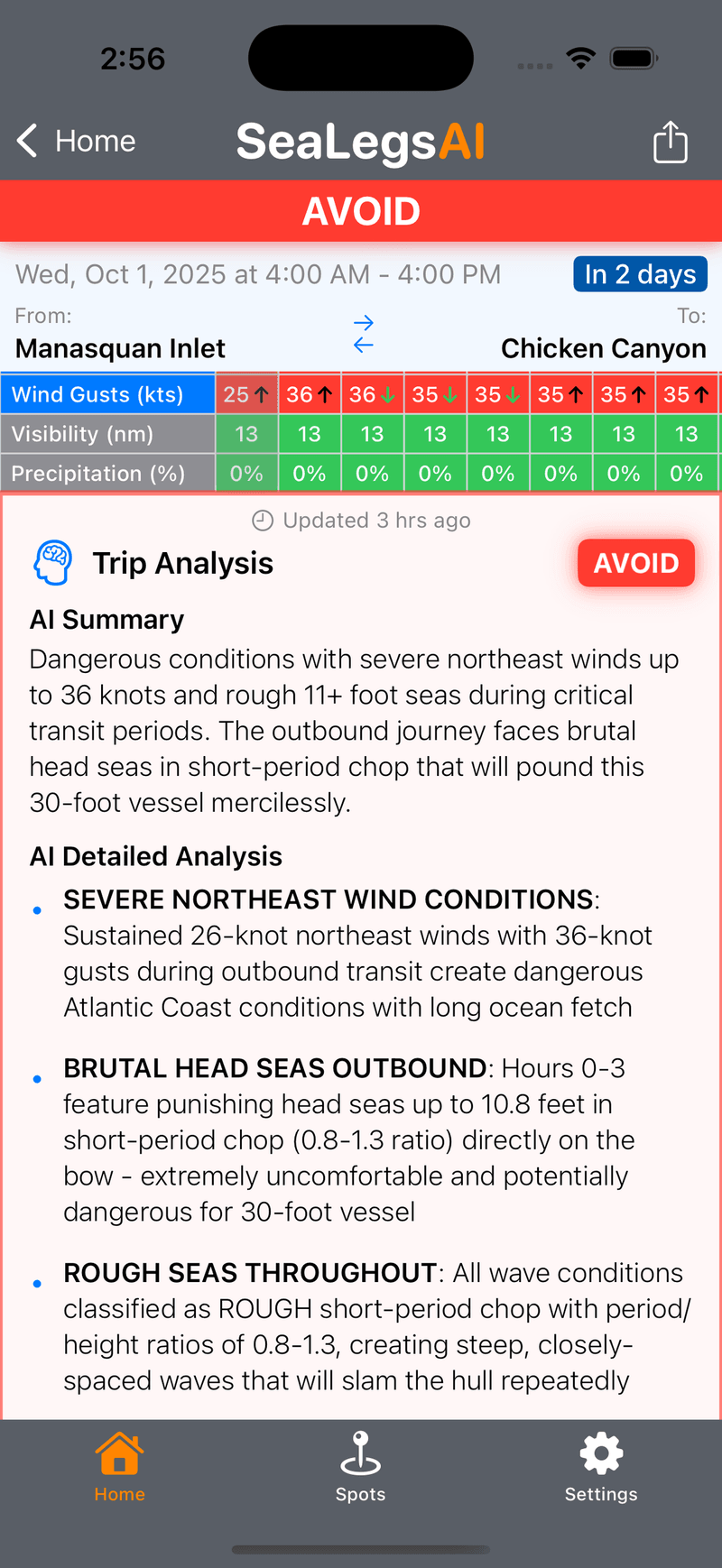
The challenge on the Brazilian coast is that a single zone forecast can't tell you whether the front has reached your stretch yet, or whether the swell wrapping into your bay during a ressaca is the part to avoid. "Vento sul 25 nós" covers an enormous area and a long window.
SeaLegs AI narrows it to your trip: point-specific wind, gust, wave height, and wave-period forecasts for your exact launch spot and departure time, turned into a plain Go, Caution, or Avoid call. The forecast names the wind; SeaLegs tells you what it's doing to the water where you'll actually be.
The bottom line
- The alísios are the northeast's steady E trade winds — 15–30 kt, most reliable June–December, building each afternoon.
- A frente fria brings the vento sul — a sudden southerly change and building sea, ~3–4 times a month in the south.
- A ressaca is wind + wave + tide stacking against the coast — worst on spring tides, most common in winter and spring.
- Extratropical cyclones drive the south's biggest seas; true tropical cyclones are rare in the South Atlantic.
- The season is inverted, and a point forecast for your exact spot beats any zone average.