San Diego Offshore Fishing ReportWeek of Sep 14 · out of San Diego Bay Inlet
Weekly report · published Friday, September 18, 2026
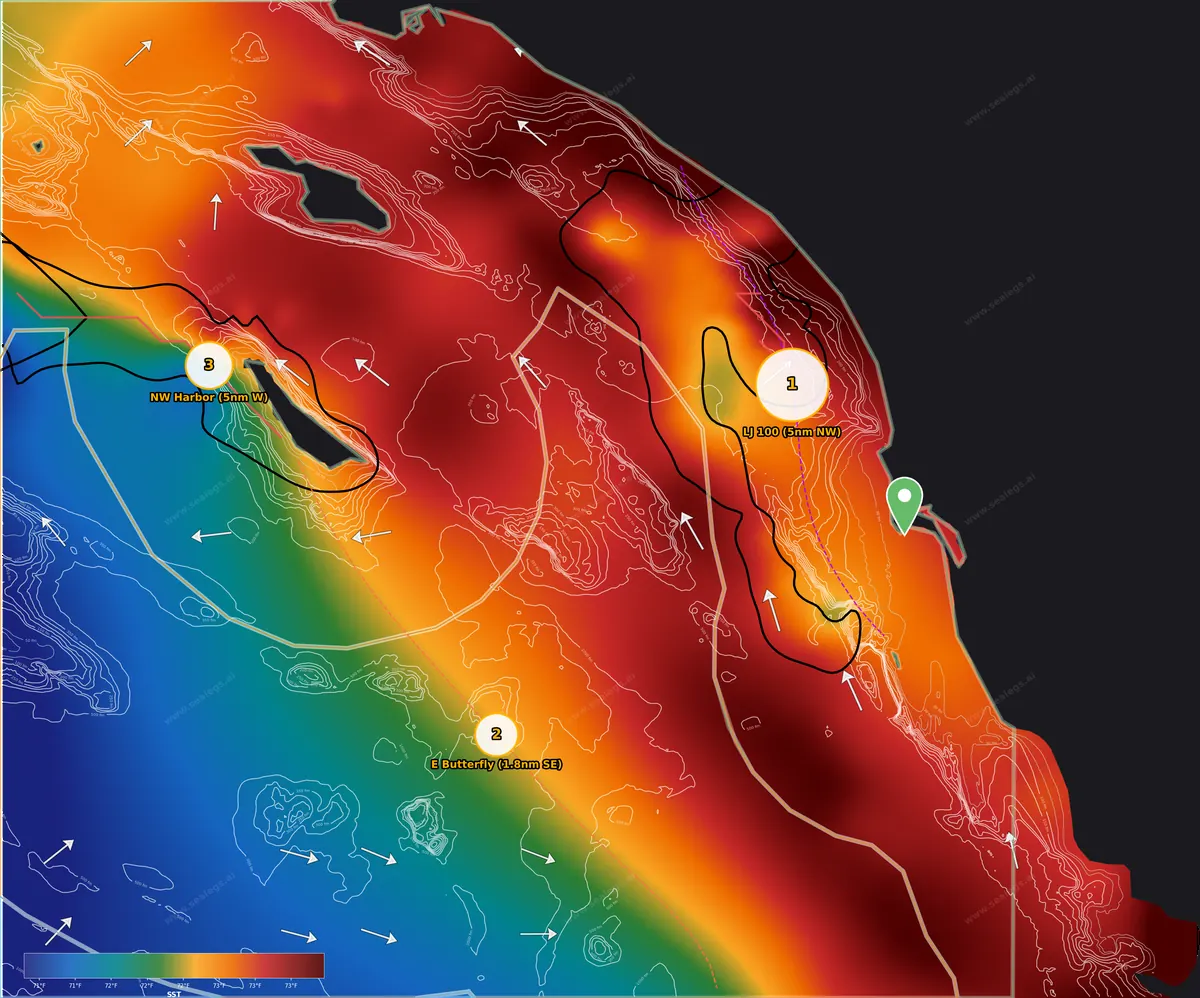
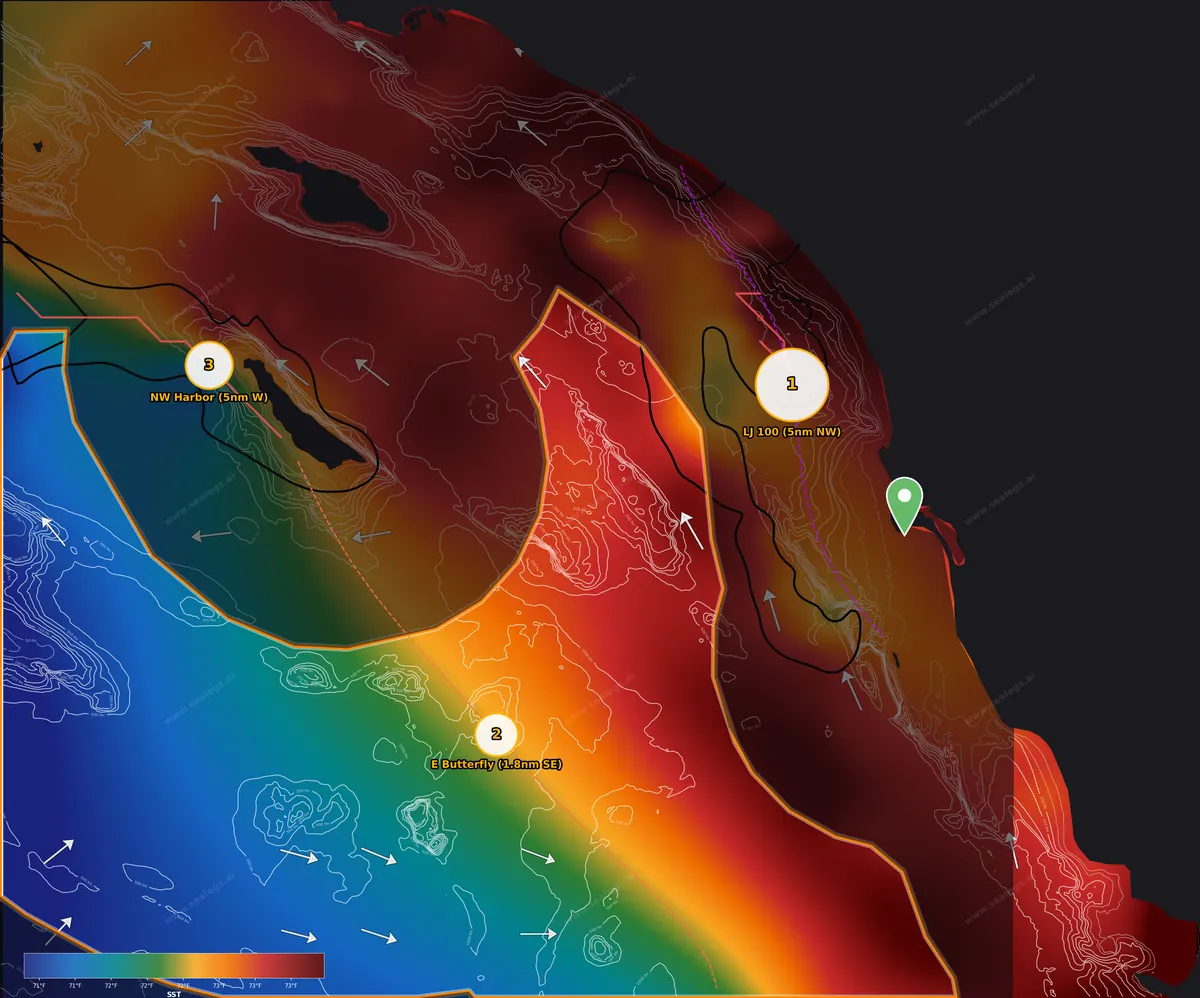
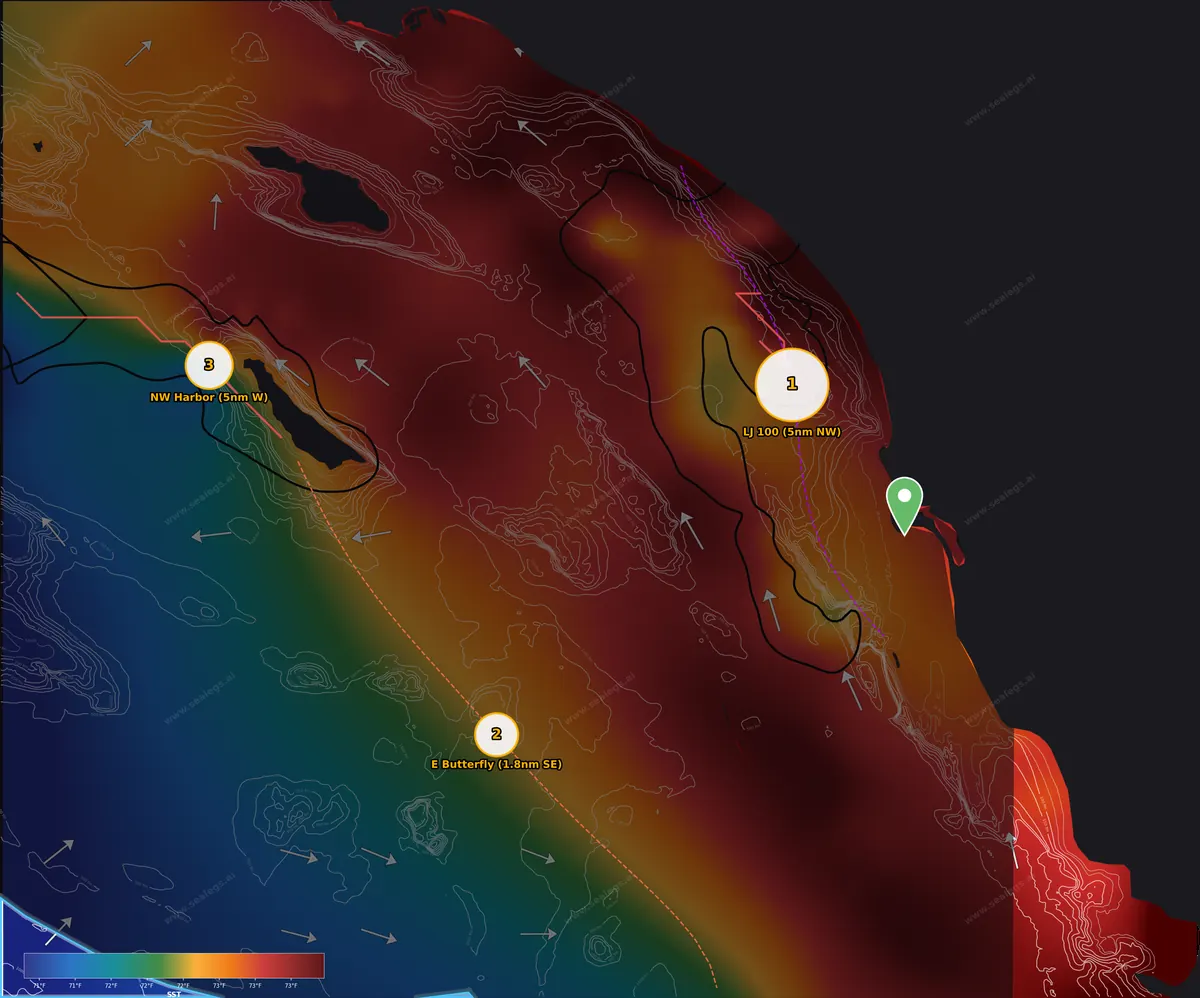
Sea surface temperature. Warm-to-cool breaks are where bait and pelagics stack.
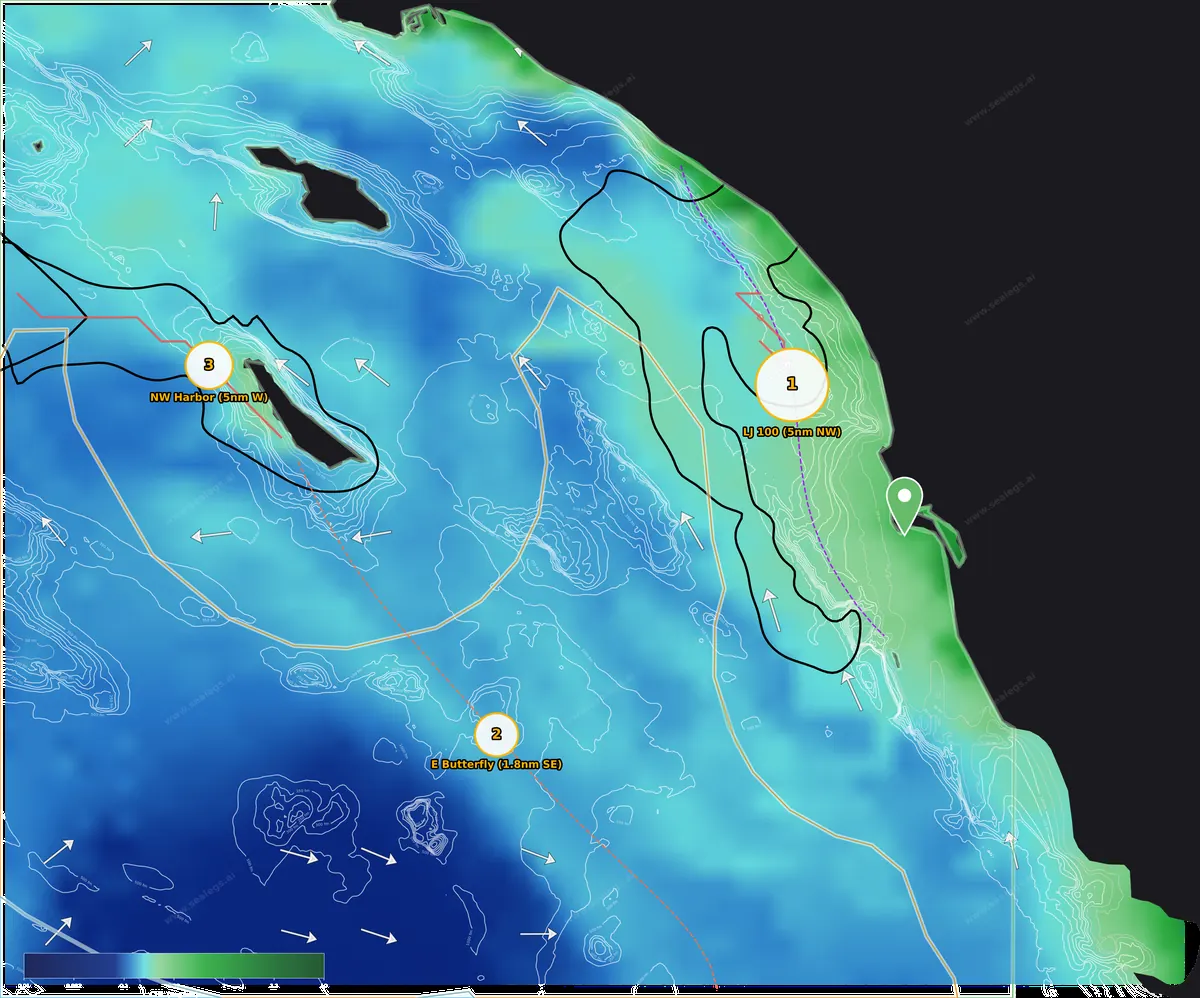
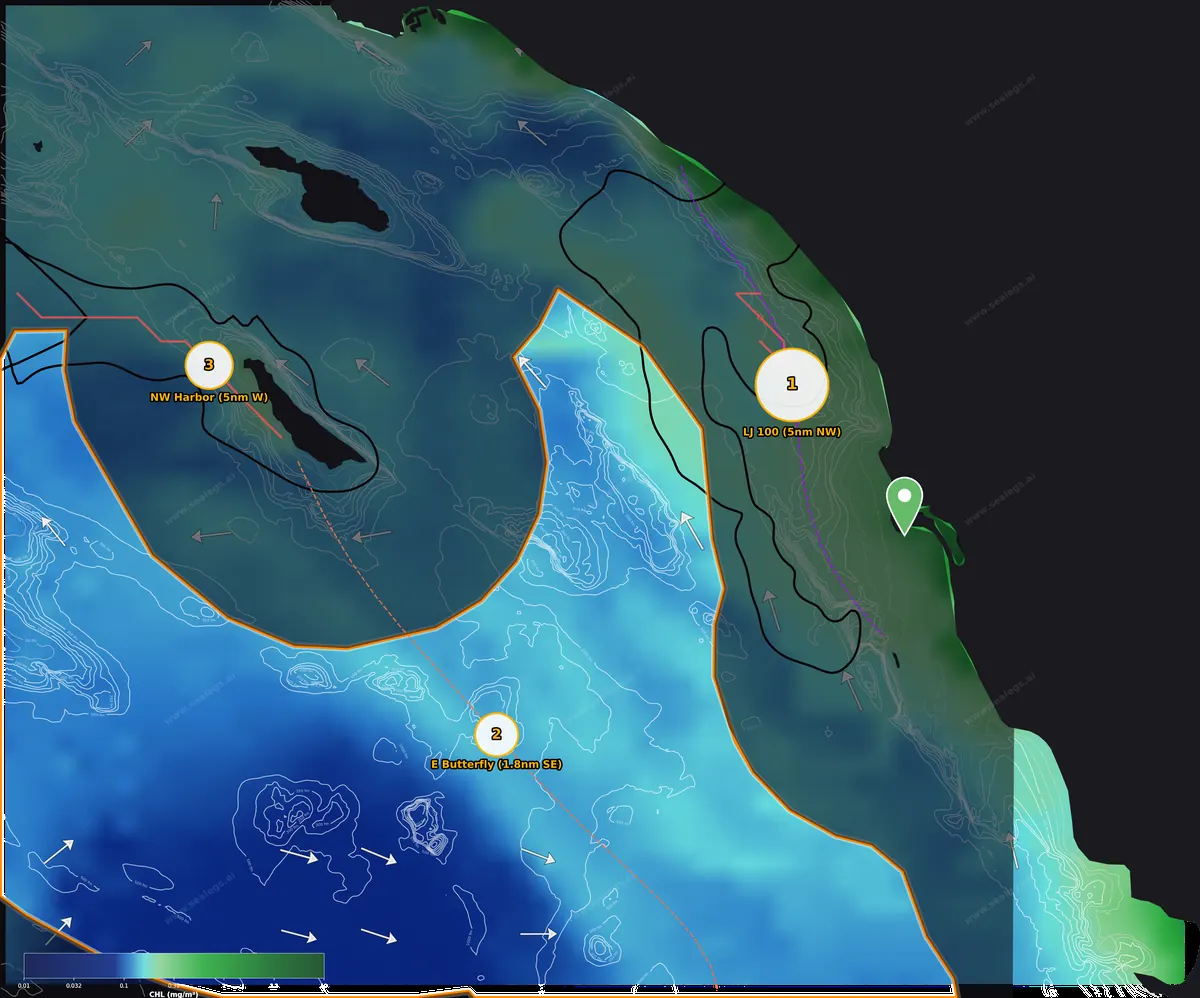
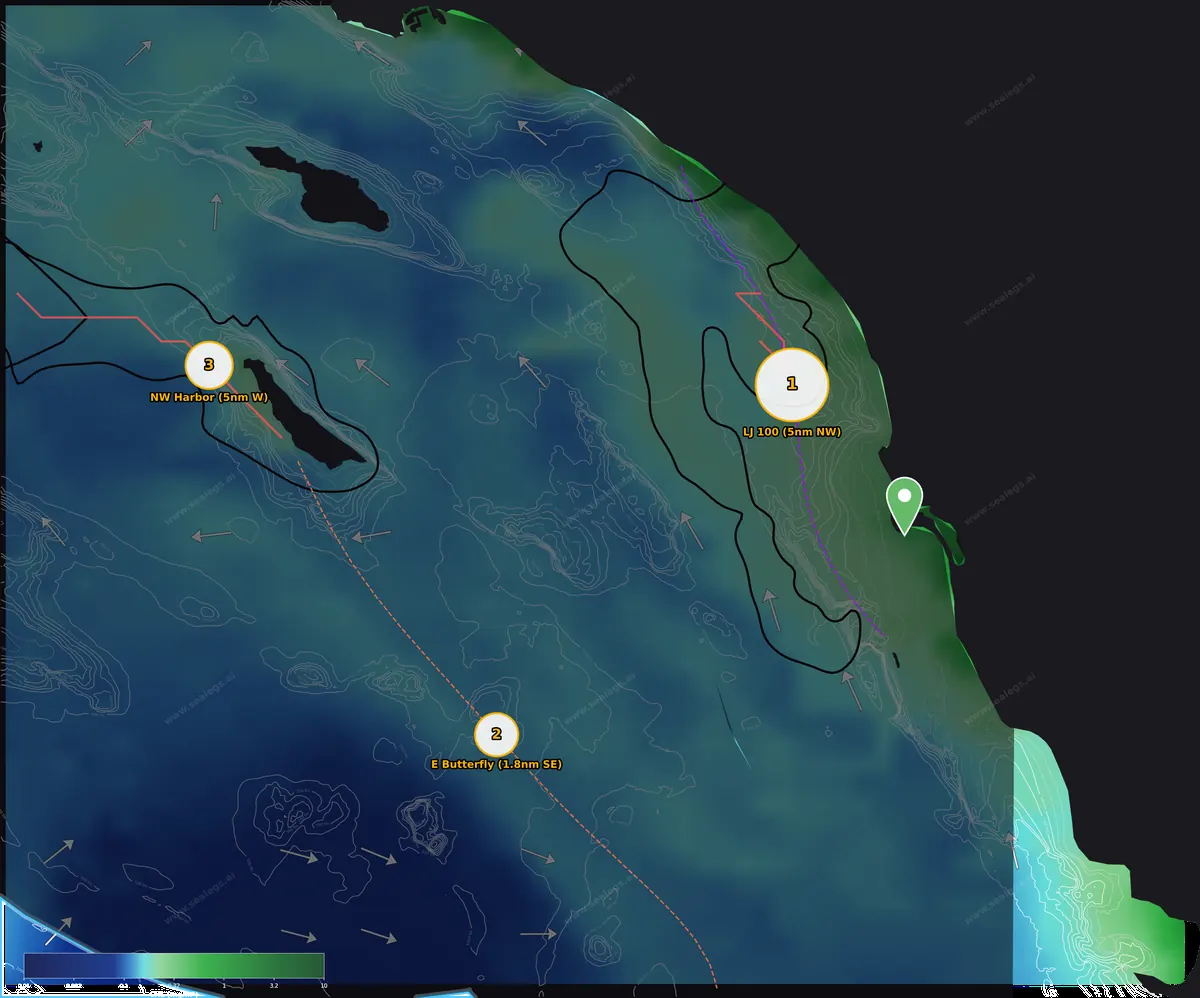
Chlorophyll. Green-to-blue color edges mark where productive water meets clean blue water.
This week's read
The best water this Friday sits right out the front door. A 1.4°F temperature break and a real green-to-blue color change stack up together over the La Jolla Canyon complex about 22 miles out, with the current pushing north along the edge — that's the convergence to fish, and the inshore forecast is GO with a glassy morning before the afternoon westerly fills in. Farther out, a warming trend has held for two days over the Butterfly Bank, worth a shot for bluefin and yellowtail if you keep the midshore CAUTION window in mind and are headed home by late afternoon. The San Clemente Island break is the cleanest edge on the chart but it's a long haul across lumpy water. Offshore beyond 60 miles is a NO-GO all three days. Anchovy is the game: bluefin and yellowtail on the cool side of the breaks, mahi on any paddy in the warm side.
- InshoreGO
- MidshoreCAUTION
- OffshoreNO-GO
Boating calls for Friday, Sep 18 from San Diego Bay Inlet. 3-day board in each zone below.
Inshore (0-20nm)
Friday is a GO inshore, calmest in the morning, and the spot to run is LJ 100 (5nm NW) where a 1.4°F break lines up with a 7-fold green-to-blue color change over the La Jolla Canyon complex with current sweeping north along the edge. Work the clean southwest side for bluefin and yellowtail on flylined anchovies, and hit any kelp paddy on the warm northeast side for mahi. NW Harbor (5nm W) off San Clemente is a tighter 1.5°F edge but it's a 76-mile run that crosses rougher midshore water.
- Fri Sep 18GO
Friday is GO all day with the calmest conditions in the morning — 3–7 knot NNW winds and 3.0-foot swells at 10–11-second periods from the SW. Afternoon winds build to 14 knots WNW with gusts to 20 knots and seas to 3.9 feet at 7-second periods — still manageable but livelier. Moderate model confidence; wave period forecasts show some spread.
- Sat Sep 19GO
Saturday is GO all day with the best window in the morning — winds drop to 4–5 knots NNE and swells run 3.5 feet at 8-second periods from the west. Afternoon brings 10–12 knot WNW winds with gusts to 16 knots before easing by evening. Wave period models show high uncertainty, so actual swell spacing may vary.
- Sun Sep 20GO
Sunday is GO all day with the lightest winds of the weekend — near-calm 1–4 knots in the morning and 3.5-foot swells at 8-second periods from the west. Afternoon sea breeze reaches 10–11 knots WNW with gusts to 15 knots before easing by evening. Highest confidence day at 84%; wave period estimates carry some uncertainty.
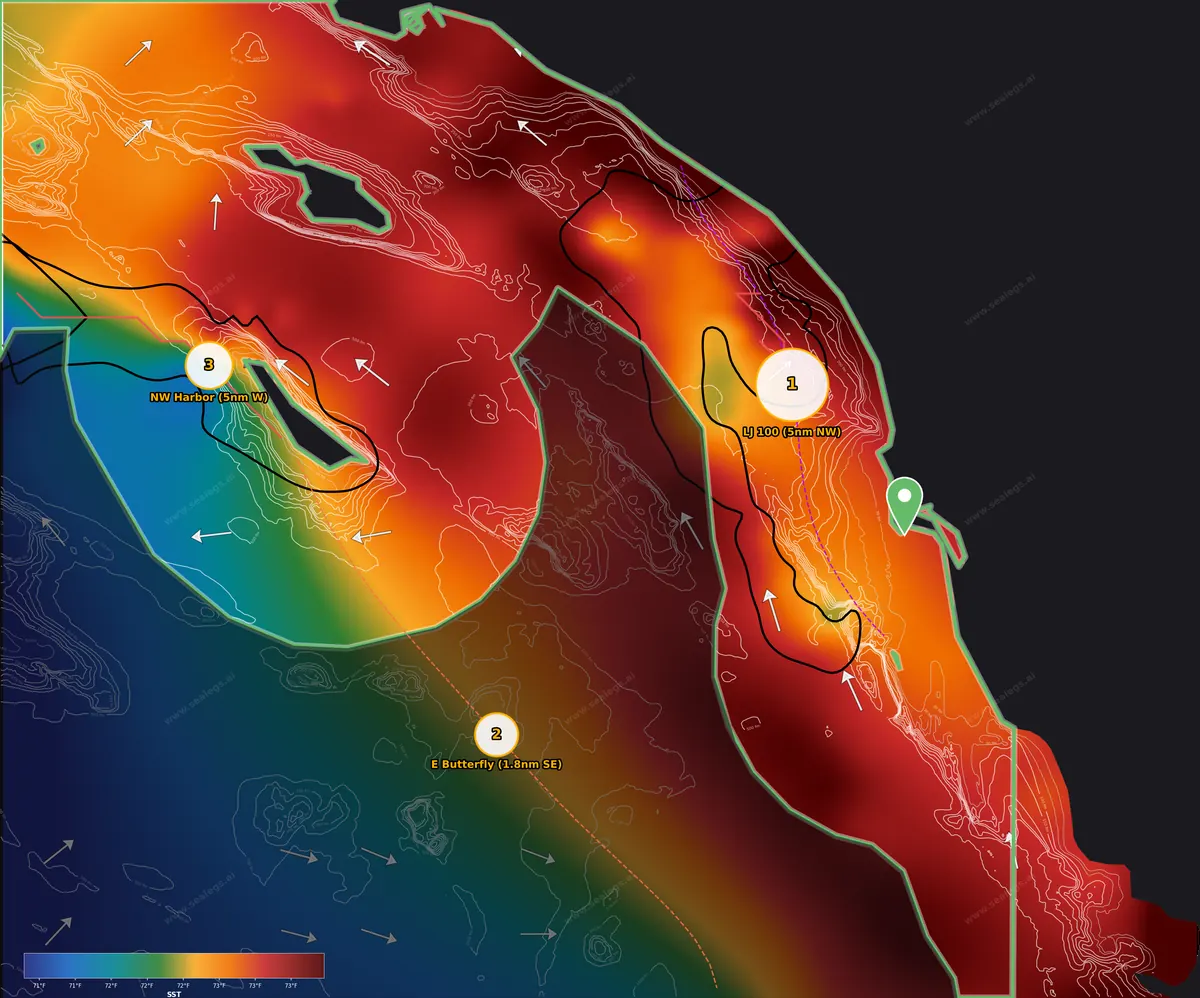
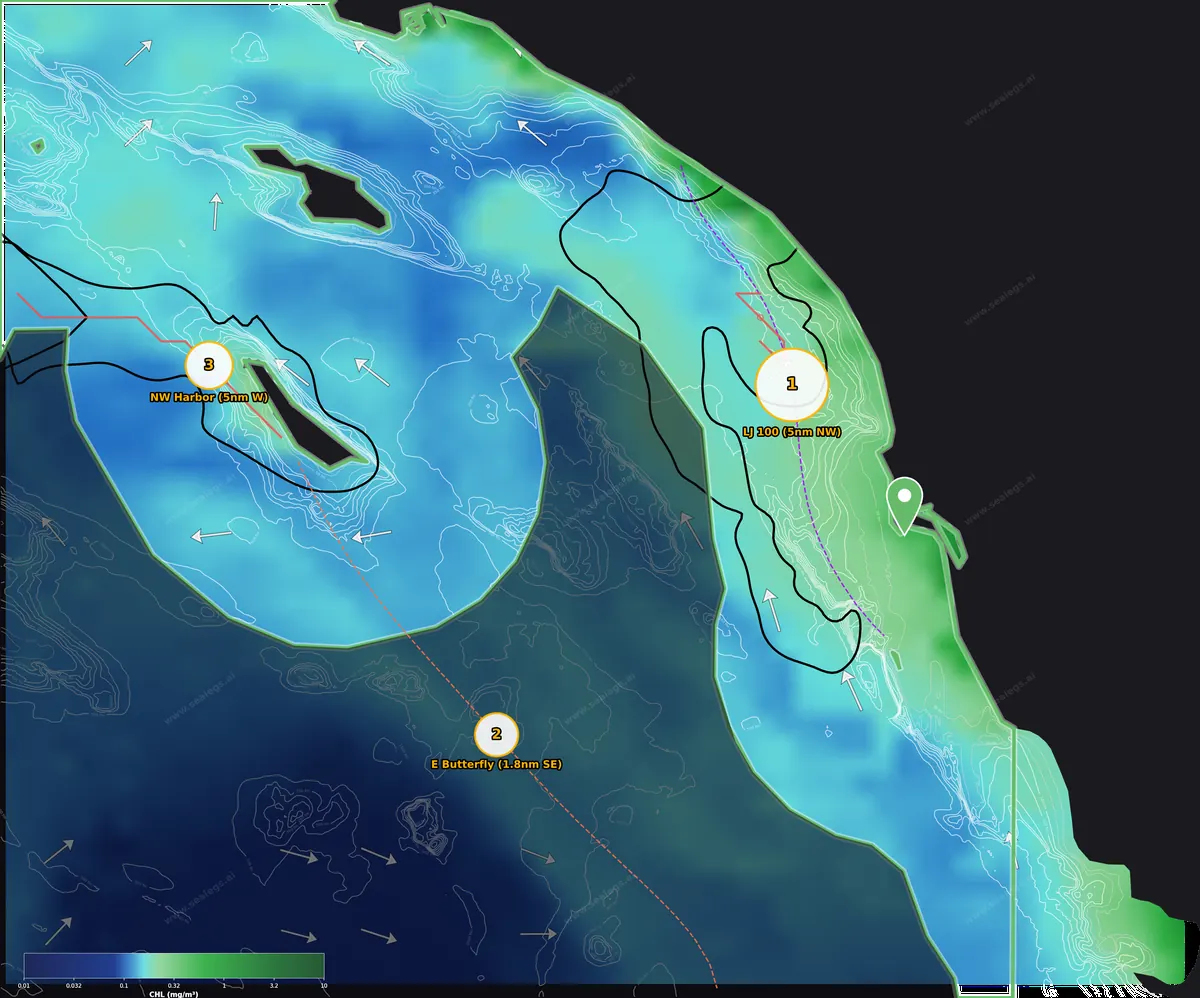
Friday is GO all day inshore — 3–7 knot NNW winds and a long-period 3-foot SW swell in the morning, building to 14 knots WNW with gusts to 20 and 3.9-foot seas by afternoon. Get out early, fish the morning and midday, and expect a livelier ride home.
The headline is the LJ 100. Three signals converge here: a moderate SST front carrying a 1.4°F break (warm side NE), a gradient peak marking the steepest part of that break, and a moderate CHL color break that jumps 7.3x from 0.16 to 1.16 mg/m³ across a 13-mile transition with the green water lying to the northeast. The spot sits five miles northwest of the LJ 100 and five miles northwest of the La Jolla Canyon, with Carlsbad Canyon six and a half miles to the north — so this break is lying over the canyon complex, and the surface current arrows along this stretch are pushing north-northwest along the edge, which keeps the boundary tight and rakes bait along the canyon walls. Water on the warm northeast side of the break is running about 73°F at the surface; the cool southwest side is the clean blue water the tuna want.
How to fish it: the productive green water is NE and inshore, and that's where the anchovy will be stacked. Bluefin and yellowtail are sight feeders here, so set up on the clean southwest side of the break and let the bait come to you. The warm layer holds only to about 31 ft (73°F) and the temperature falls fastest from 31 to 61 ft (down to 69°F) — that 30–60 ft band is where the anchovy pin up and where the bluefin will be, so fish flylined anchovies for the surface stage and drop a sinker-rigged anchovy to 40–60 ft if they won't come up. Yellowtail will work closer to the green edge itself; a live Pacific mackerel or a yo-yo iron worked through the thermocline layer covers them. On the warm northeast side, glass for kelp paddies — this 73°F water in September is mahi water, and any paddy along the break line is worth a stop with live anchovy or sardine. The moon is a half-lit waxing crescent, eight days before full, so there's no overnight gorging to worry about — expect a steady daytime bite with a bump in the early-afternoon moonrise window around 1:30–2:30 PM, which is right before the wind builds.
Farther west, the NW Harbor off the north end of San Clemente Island shows the tightest edge on the chart — a moderate SST front with a 1.5°F break compressed into a 5-mile transition, warm side NE, sitting in 71°F water with the current pulling northwest around the island. That's textbook bluefin and yellowtail temperature and the break runs along the island's steep deep-water side. Bluefin work the cool side; yellowtail and Pacific bonito will be on the warm side and tight to the edge on anchovy. The catch is distance: the spot is 76 miles from San Diego and the run crosses midshore water that carries a CAUTION call Friday with a confused cross-sea and a 6 PM deadline. Only consider it as a long-range or overnight play with a settled boat, and weigh the shorter La Jolla run first.
A second thermal front also lies west of La Jolla around 117.7°W in the 30-mile range, connecting the inshore and midshore water — troll the corridor between the LJ 100 and that line if the canyon break goes quiet.
Midshore (20-60nm)
Friday is CAUTION midshore with a usable window through 6 PM and a confused cross-sea all day. The one play is E Butterfly (1.8nm SE), where a gradual 1.5°F warming trend has held over the Butterfly Bank for two days — long enough for anchovy to settle on the high spot. Meter the bank for bluefin and yellowtail in the 30–60 ft band and check the drift for paddies holding mahi, but be headed home well before the evening blow.
- Fri Sep 18CAUTION
Friday is CAUTION with a usable window from midnight to 6:00 PM — plan to be back before then. A confused cross-sea (S swell crossing WNW wind-wave) creates awkward motion all day. After 6:00 PM, seas build to 5 feet with 22-knot gusts — avoid departing into that window.
- Sat Sep 19CAUTION
Saturday is CAUTION with a window from 1:00 AM to 1:00 PM for a 12-hour trip. Winds are light at 11-14 knots northwest, but 4.5-4.9 foot seas at 7-second periods from the west persist all day. After 2:00 PM, wave heights hold near 4.9 feet through midnight — plan accordingly.
- Sun Sep 20CAUTION
Sunday is CAUTION but has the best window of the forecast: 2:00 AM through midnight is all-GO for a 12-hour trip. Winds ease to 8-12 knots northwest, and seas gradually drop from 4.7 to 4.3 feet at 8-second periods from the west. The first two hours of the day are the only ones to avoid.
Friday is CAUTION midshore — a usable window from midnight to 6 PM, but a south swell crossing a WNW wind-wave makes for awkward motion all day, and after 6 PM seas build to 5 feet with 22-knot gusts. Fish it only if you can be back before late afternoon. Saturday is similar with a window closing around 1 PM; Sunday is the best of the three midshore days with an all-day window and easing seas.
The one spot with signal is the E Butterfly, sitting two miles southeast of the E Butterfly high spot on the Butterfly Bank, with San Salvador Knoll ten miles to the east-northeast. The SST feature here is broad — a 1.5°F step spread across an 18-mile transition with the warm side to the northeast — so treat this as a gradual warming across the bank rather than an edge to troll. What earns it a look is that this warming has held position for two days, giving the anchovy time to gather around the bank's structure, and the water is clean blue 72°F at the surface (midshore chlorophyll averages just 0.12 mg/m³) — exactly the visibility bluefin want. There's a light 0.2-knot current setting toward the southeast across the bank, which will push bait onto the down-current side.
Fish it like a bank: meter the up-current and down-current edges of the high spot for anchovy balls and bluefin marks. The warm layer here holds to about 35 ft (72°F) and the fastest temperature drop runs from 31 to 61 ft (down to 69.6°F) — bluefin will be hanging in and just under that 30–60 ft band, so flyline anchovies on the surface fish and send sinker-rigged anchovies to 50–60 ft when they're down. Yellowtail should be on the structure itself in this 72°F water — a yo-yo iron or a live Pacific mackerel dropped to the top of the bank covers them. And with 72–73°F water and September timing, any kelp paddy you find drifting across the bank on the southeast set is a mahi stop; work live anchovy or sardine up-current of the paddy. With a half moon and no night feeding pressure, the daytime bite should be steady; the moonrise bump around 1:30–2:30 PM is a good final push before you point it home ahead of the evening deterioration.
Offshore (60-150nm)
Offshore is NO-GO Friday, Saturday and Sunday — a confused SSW-on-NW cross-sea with gusts to 24 knots and seas near 6 feet. There are no surface breaks or color changes worth the run out there anyway; the water beyond 60 miles is uniformly clean 71°F blue with no edges. Postpone the offshore trip until the pattern settles.
- Fri Sep 18NO-GO
Friday is NO-GO for the 12-hour trip. A confused cross-sea — SSW swell crossing NW wind-wave — creates unpredictable, multi-directional motion all day. Conditions worsen by evening with 18-knot NW winds, gusts to 24 knots, and seas building to 5.7 feet.
- Sat Sep 19NO-GO
Saturday is NO-GO for the 12-hour trip. A brief mid-morning lull brings waves down to around 5.2 feet at 7-second periods from the WNW with 14–16 knot NW winds, but it's too short and rough to support a 12-hour departure. Conditions worsen again by 5:00 PM.
- Sun Sep 20NO-GO
Sunday is NO-GO for the 12-hour trip. Winds ease to 10–14 knots NW mid-day — the calmest of the forecast — but waves remain 4.9–5.3 feet at 7–8 second periods from the WNW, too rough for a 12-hour departure. No settled window of sufficient length exists.
Offshore is NO-GO on all three days. Friday brings a confused cross-sea — SSW swell crossing NW wind-wave — with 18-knot NW winds, gusts to 24 and seas building to 5.7 feet by evening. Saturday and Sunday offer only brief lulls, never a settled window long enough for a 12-hour run. Postpone any trip beyond 60 miles until this pattern breaks.
There is also no ocean reason to force it. No qualifying spots set up in the offshore zone: the water out there is uniformly clean 70.5–71.2°F blue (chlorophyll averaging 0.087 mg/m³) with no temperature breaks, color changes or eddies to concentrate bait. That temperature is right in the bluefin and albacore window, but without an edge or a bait signal the fish will be scattered. When the weather settles, look for the warming trend now over the Butterfly Bank to push farther offshore and create an edge worth hunting; until then, the inshore canyon break off La Jolla is the far better use of a September day.
Top spots this week
Ranked by signal strength, how long the feature has held, and how far the run is.
- 1
5 nm NW of LJ 100
Inshore · 73.1°F · Bluefin tuna, yellowtail, mahi-mahi
Only true multi-signal spot on the chart: a 1.4°F SST break stacked on a 7.3x green-to-blue color change over the La Jolla Canyon complex with current running along the edge — bait side NE, clean side SW for bluefin and yellowtail, 73°F paddy water for mahi. GO weather Friday with a calm morning, and just 22nm from San Diego.
- 2
1.8 nm SE of E Butterfly
Midshore · 72.4°F · Bluefin tuna, yellowtail, mahi-mahi
Broad 1.5°F warming trend that has held over the Butterfly Bank for two days in clean 72°F water — structure plus persistence gives anchovy time to gather for bluefin and yellowtail, with paddy mahi possible. CAUTION Friday with a usable window through 6 PM; 50nm run.
- 3
5 nm W of NW Harbor
Inshore · 71.1°F · Bluefin tuna, yellowtail, Pacific bonito
Sharpest edge on the chart — a 1.5°F break in a 5nm transition in 71°F bluefin/yellowtail water along San Clemente's deep side — but a 76nm run across CAUTION midshore water Friday makes it a long-range or overnight option, not a day trip.
Run distances from your inlet
Straight-line distance and heading from each inlet to this week's ranked spots. Plan fuel for the real route, and for the ride home.
From San Diego (Point Loma)
This week's #1 spot, 5 nm NW of LJ 100, is 20 nm NW (326°). This week's report was run from here.
From Mission Bay
This week's #1 spot, 5 nm NW of LJ 100, is 17 nm NW (319°).
From Oceanside Harbor
This week's #1 spot, 5 nm NW of LJ 100, is 14 nm SSW (194°).
From Dana Point Harbor
This week's #1 spot, 5 nm NW of LJ 100, is 31 nm SSE (158°).
From Newport Beach
This week's #1 spot, 5 nm NW of LJ 100, is 42 nm SSE (150°).
From Avalon (Catalina)
This week's #1 spot, 5 nm NW of LJ 100, is 49 nm ESE (117°). The closest ranked spot is #3 5 nm W of NW Harbor, 26 nm SW in the inshore zone.
Today's conditions on the grounds
Live SpotCast forecasts, refreshed every morning, between weekly reports.
San Diego
Cortez Bank
About the San Diego fishing report
This is the weekly San Diego offshore fishing report from SeaLegs AI. Every week we run a full DeepCast report out of San Diego and publish it here: satellite sea surface temperature and chlorophyll, the temperature breaks and color edges worth running to, the banks and high spots they sit on, and a GO / CAUTION / NO-GO boating call for the inshore, midshore and offshore water.
Out of Point Loma the offshore game is a map of banks: the Nine Mile, the 302, the 425, and farther out Tanner and Cortez. Warm water sliding up from Mexico can put tuna and yellowtail on any of them in a week, and it can leave just as fast. One report covers the coast from Newport Beach down to the border. Distances from each harbor to this week's spots are listed below.
San Diego fishing report FAQ
What is the offshore fishing outlook off San Diego Bay Inlet this week?
Offshore is NO-GO Friday, Saturday and Sunday — a confused SSW-on-NW cross-sea with gusts to 24 knots and seas near 6 feet. There are no surface breaks or color changes worth the run out there anyway; the water beyond 60 miles is uniformly clean 71°F blue with no edges. Postpone the offshore trip until the pattern settles.
How is the midshore fishing off San Diego Bay Inlet this week?
Friday is CAUTION midshore with a usable window through 6 PM and a confused cross-sea all day. The one play is E Butterfly (1.8nm SE), where a gradual 1.5°F warming trend has held over the Butterfly Bank for two days — long enough for anchovy to settle on the high spot. Meter the bank for bluefin and yellowtail in the 30–60 ft band and check the drift for paddies holding mahi, but be headed home well before the evening blow.
Where is the best inshore fishing near San Diego Bay Inlet this week?
Friday is a GO inshore, calmest in the morning, and the spot to run is LJ 100 (5nm NW) where a 1.4°F break lines up with a 7-fold green-to-blue color change over the La Jolla Canyon complex with current sweeping north along the edge. Work the clean southwest side for bluefin and yellowtail on flylined anchovies, and hit any kelp paddy on the warm northeast side for mahi. NW Harbor (5nm W) off San Clemente is a tighter 1.5°F edge but it's a 76-mile run that crosses rougher midshore water.
How far are this week's spots from San Diego (Point Loma), Mission Bay, Oceanside Harbor, Dana Point Harbor, Newport Beach and Avalon (Catalina)?
The run-distance table on this page gives the straight-line distance and heading from each inlet to this week's number one spot and to the closest ranked spot.
How often is the San Diego fishing report updated?
Every week. Each week SeaLegs AI features one DeepCast report for the San Diego region, and this page is rebuilt from it. This edition was written for Friday, September 18, 2026 out of San Diego Bay Inlet.
What is DeepCast?
DeepCast is SeaLegs AI's offshore fishing report. It reads satellite sea surface temperature, chlorophyll, currents and bathymetry around your departure port, finds temperature breaks and color edges, ranks the spots worth running to, and pairs them with a GO / CAUTION / NO-GO boating forecast for each zone. You can run one for any port for $4.99.
Get this report for your own inlet
This is one featured DeepCast report a week. In the SeaLegs AI app you can run one out of any port, for any day, whenever you want: temperature breaks, color edges, ranked spots, and a GO / CAUTION / NO-GO call for each zone. $4.99 a report, no subscription.


Decision-support guidance only. Marine weather can change rapidly, and conditions on the water often differ from forecasts. The captain is solely responsible for all go/no-go decisions and must check the official NWS marine forecast and warnings before getting underway. Satellite data: NASA, Copernicus Marine, Open-Meteo, DWD.